


(April 7, 2026) Recognized as one of the foremost Odissi dancers of her generation, Arushi Mudgal has built a body of work that balances technical rigor with a deeply internalized understanding of the form.
Raised in one of India’s most storied artistic households and trained under her aunt and guru Madhavi Mudgal at Delhi’s iconic Gandharva Mahavidyalaya, one of India’s oldest and most prestigious institutions for classical arts, with a legacy spanning over eight decades, Arushi represents a rare continuity of lineage and reinvention. She grew up in close proximity to some of the greatest names in Indian classical music and dance, luminaries whose true stature she would only fully appreciate years later. By the time she was a teenager, she was already touring Europe, the United States, and Latin America, carrying a form steeped in centuries of tradition to audiences encountering it for the very first time.
Her work spans traditional repertoire, original choreography, and international collaborations, including projects like Orfeo: Crossing the Ganges and Sama. Its a body of work that drew global recognition when critic Alastair Macaulay named her one of India’s most remarkable dancers, placing her among The New York Times‘ Top Ten Dancers of 2018. Her contributions to Odissi have earned her many awards, most notably, the Ustad Bismillah Khan Yuva Puraskar by the Sangeet Natak Akademi, the Guru Kelucharan Mohapatra Yuva Pratibha Samman, and the President’s Bal Shree Award, among several others. Yet, beneath the accolades and touring schedules lies a practice shaped by years of learning and dedication, teamed with an innate ability to grow and evolve.
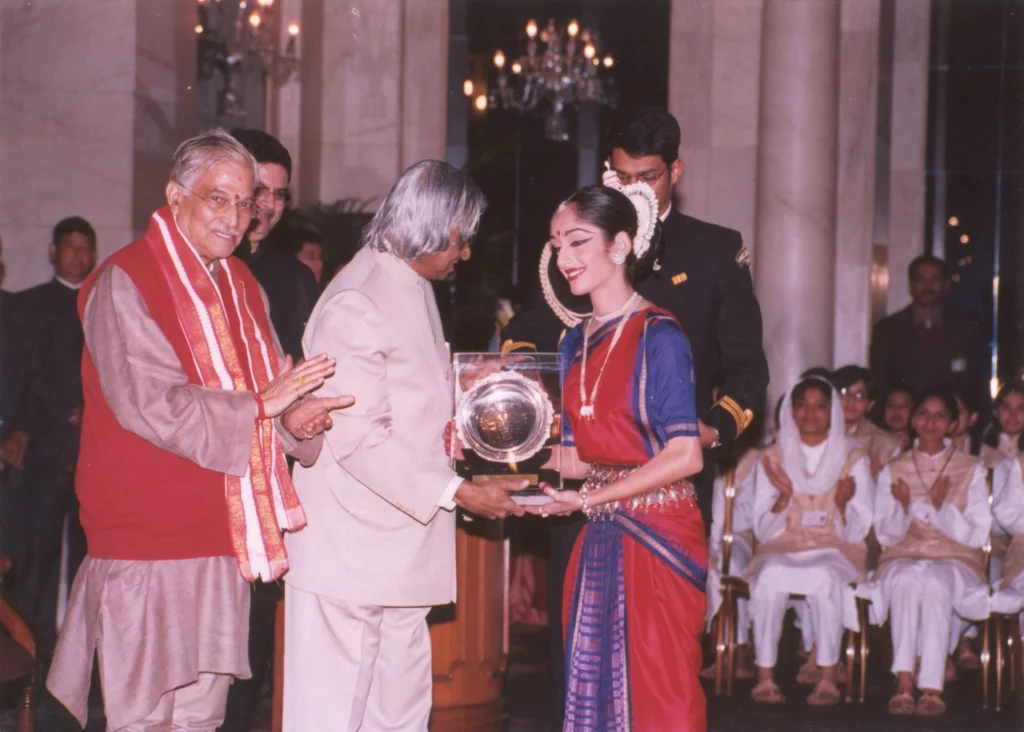
Arushi Mudgal received Bal Shree Award from President APJ Abdul Kalam in 2002
Born into a living tradition
For Arushi, dance was the natural environment she was born into. Her grandparents, Pandit Vinay Chandra Maudgalya and Padmadevi Maudgalya, founded Gandharva Mahavidyalaya in 1939, an institution that would go on to become one of India’s most respected homes for classical arts education, nurturing generations of practitioners and shaping the cultural landscape of the country. The institution he founded grew to become a noted arts centre, with renowned musicians and dancers such as Annapurna Devi, Ravi Shankar, Shambhu Maharaj, Kumar Gandharva, Malini Rajurkar, and Mallikarjun Mansur associated with it.
Arushi’s father, Madhup Mudgal, and her extended family ensured that music and dance were not occasional pursuits but a constant presence. “It was never formal in the way people imagine,” she says in a chat with The Global Indian, with simple gestures, flowing with a dancer’s grace. “We weren’t sitting and being told, ‘This is tradition, this is legacy.’ It was simply happening around us all the time.”
As children, she and her sister (Hindustani vocalist Sawani Mudgal) would run through corridors filled with rehearsals, sometimes pausing to watch, sometimes drifting in and out of classes. At annual festivals, they would be just as likely to be found selling brochures or falling asleep in auditorium seats as watching legends perform.
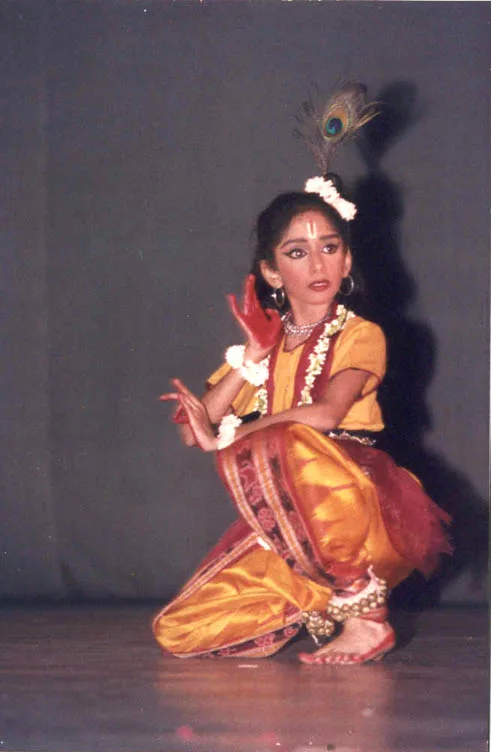
Arushi during a childhood performance
Legends who felt like family
Only later did the magnitude of those early encounters sink in. Growing up in the Gandharva Mahavidyalaya ecosystem meant rubbing shoulders with some of the tallest figures in Indian classical arts like Ravi Shankar and Zakir Hussain, learning a great deal about music and life simply by being around them, even if it all felt, at the time, almost ordinary.
For Arushi, some of her earliest and most formative memories are intertwined with the presence of icons like the doyen of Odissi, Kelucharan Mohapatra, and the legendary vocalist Kumar Gandharva, though at the time they felt less like legends and more like family.
“I had such a close association with Guruji,” she recalls, speaking of Kelucharan Mohapatra. “Now when people say they’ve only watched him on YouTube, it just dawns upon you: my God, we were travelling together; he would be telling us stories, joking with us. it was almost like he was a friend.”
She remembers simple, intimate moments: going to watch films with him when he stayed over in Delhi, or laughing over his quirks, like mixing gulab jamun syrup into dal. Similarly, her bond with Kumar Gandharva, whom she affectionately calls Bade Baba, was deeply personal. “He would stay with us whenever he came, and there are such vivid, ordinary memories,” she says, recalling moments that, in hindsight, feel extraordinary.
Looking back, she feels especially grateful for a childhood where such encounters were unrecorded and unfiltered: “Those moments were just for us, and they remain here,” she says, pointing inward, “and that makes them very special.”
View this post on Instagram
The freedom to choose
Despite being born into one of India’s most respected artistic lineages, Arushi is clear that there was never any implicit or explicit pressure to follow that path. “It might sound strange, but there was none at all,” she says.
In fact, she recalls that her family, deeply immersed in music and dance, was equally open to her choosing an entirely different profession. “If I had said I wanted to do something else, say hotel management, they would have been just as excited,” she adds. If anything, she notes, her parents were acutely aware of the challenges that come with a life in the arts, which made their approach even more hands-off. The absence of pressure, perhaps, allowed her to inhabit the art on her own terms.
The world as her stage
Her earliest relationship with dance was instinctive. “I would be excited days before a performance: trying on costumes, rehearsing in front of the mirror, even revising pieces while looking out of a car window,” she recalls. That sense of anticipation, she admits, has never really left her.
Touring internationally from a young age, well before she had finished school, shaped Mudgal’s understanding of performance in profound ways. Performing in Brazil as a teenager, presenting works across European festivals, navigating stages in countries with no prior familiarity with Odissi: these early experiences gave her an instinct for communicating across cultural divides that has since become central to her practice. What struck her most was not the scale of venues but the nature of audiences.
“In Europe especially, people come to watch because they want to experience something,” she says. “They may not know anything about Indian mythology or Odissi, but they are open. And when such an audience connects with your work, it feels very pure.”
Her collaborations, too, reflect this sensibility. Working across disciplines and geographies has not diluted her practice but expanded its possibilities, allowing her to engage with different artistic vocabularies while retaining a strong core.
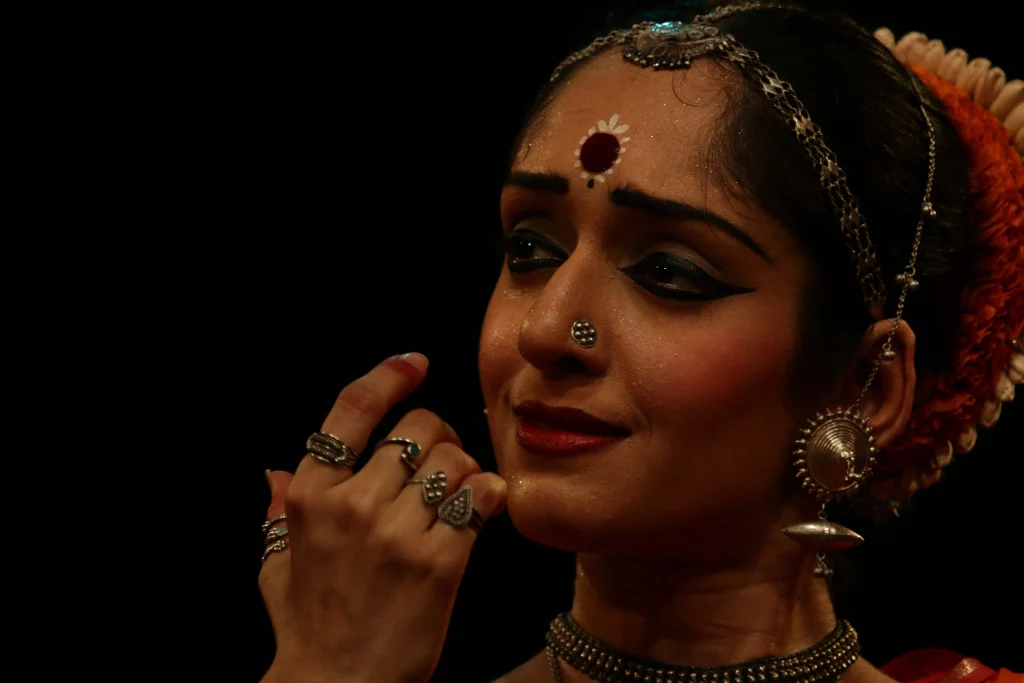
Between discipline and discovery
While her journey may seem seamless from the outside, it has been marked by moments of quiet but significant decisions. One such moment came during her college years at Lady Shri Ram College.
Balancing rigorous academic expectations with an increasingly demanding performance schedule proved unsustainable. “There came a point where I had to choose how much time I could give to each,” she says. Opting to pursue her degree through correspondence allowed her to commit fully to dance — a decision that, in retrospect, defined her path.
Yet, her intellectual curiosity remained intact. Returning to academics later in life, she began studying philosophy, seeking new ways to understand her practice. This inquiry found expression in her collaboration with the late scholar S. K. Saxena (who worked with the likes of Kapila Vatsayan), along with whom she co-authored a book on the aesthetics of Odissi dance, published by the Sangeet Natak Akademi.
“That experience changed how I see everything,” she says. “When you spend hours discussing a single word, you realize how layered even the simplest ideas are.”
Her relationship with dance, too, has evolved. From the sheer joy of early performances to a phase of intense discipline and self-expectation, she now finds herself in a space that values both rigor and release. “You have to be sincere, but you also have to let go at some point,” she reflects.
Passing the flame: Thoughts on the next generation
Today, Arushi is as reflective about the ecosystem of classical dance as she is about her own work. While she acknowledges the technical advancements among younger dancers, she also senses a shift in depth. “There is a lot of brilliance, but sometimes less internal engagement,” she says. “And I think audiences, too, have changed in how they receive.”
Social media, she believes, has introduced both opportunity and distortion. “It gives visibility, but it also creates a very superficial measure of worth: followers, likes. It can be difficult, especially for those who are deeply committed but not inclined to project themselves constantly.”
Her own response has been to remain grounded in practice. Teaching, though less regular now, continues through workshops, where she finds joy in adapting her approach to each student. “Every individual is different, and finding that connection is exciting,” she says.
Even her pre-performance rituals reflect a sense of balance: practice in the morning, a clear head, and a refusal to overcomplicate preparation. “You do what you need to do, and then you trust your training,” she says simply.
The pieces she returns to
Toward the end of our conversation, Arushi reflects on the works she finds herself drawn back to — though, as she puts it, “my favorites also keep changing.” Among them is Ram Ho, an abhinaya piece depicting the parting between Kaushalya and Ram on the eve of his departure from Ayodhya, which she describes as “very emotionally draining, but very fulfilling… you feel like you’ve lived a certain life and come out of it.”
In contrast, she speaks with visible excitement about Chhaliya, an Odia composition and a relatively recent choreography she has been performing — “a very playful kind of space” where she is “still finding nuances” each time she goes on stage. Another firm favorite is the Bageshree Tarana, set to a composition by the legendary Pandit Kumar Gandharva, which she enjoys for its sheer musical energy, especially in live settings, where, as she says, the experience brings “a different thrill.”
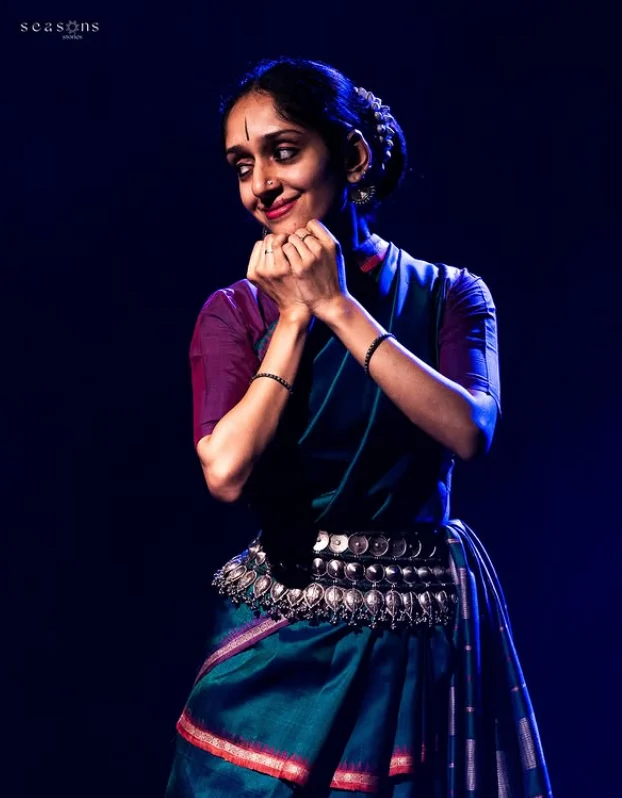
Still becoming
What continues to excite Arushi today are new explorations in choreography, in abhinaya, and in the ongoing pursuit of her master’s in philosophy. There is no fixed roadmap, no defined five-year plan. Instead, there is a steady commitment to growth, to questioning, and to remaining open.
For a dancer born into greatness, perhaps that openness is the most remarkable inheritance of all.
- Follow Arushi Mudgal on Instagram
ALSO READ: Padma Shri 2026: The grace, grit, and global journey of Kuchipudi dancer Deepika Reddy