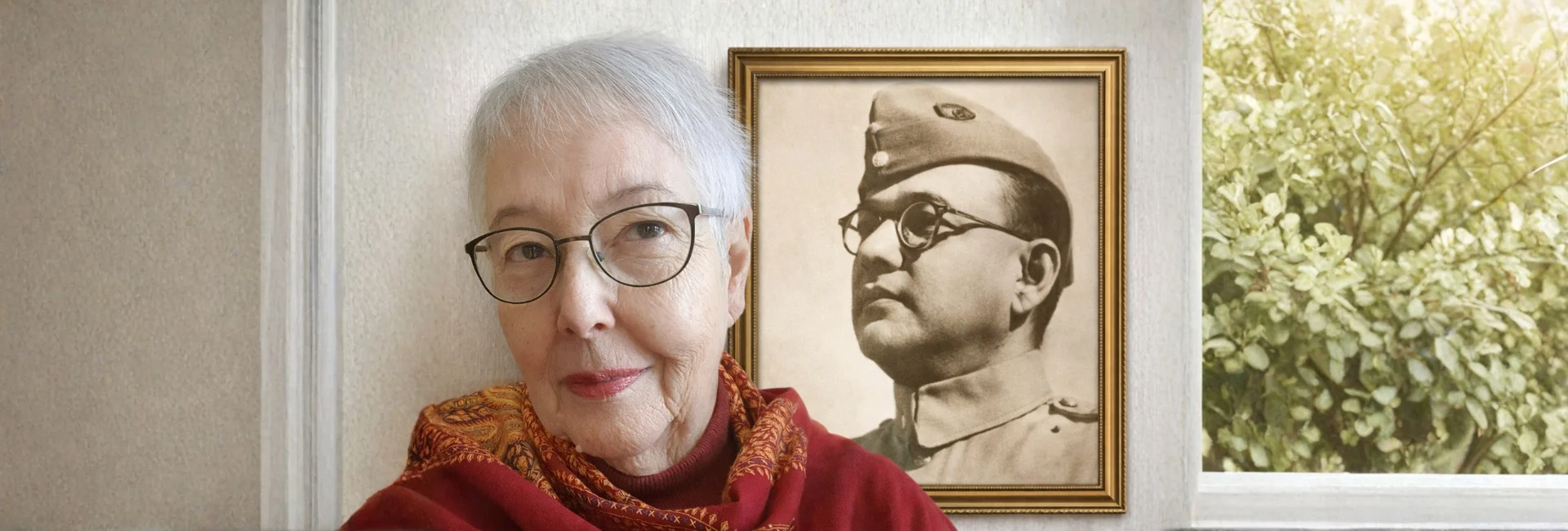


(March 8, 2026) In a wide-ranging conversation with Global Indian, Netaji Subhas Chandra Bose’s only child, raised in post-war Vienna by her mother Emilie Schenkl, speaks about her father, her mother’s life, and her own distinguished career in economics.
More than eight decades after Netaji Subhas Chandra Bose disappeared from the world stage in 1945, the affection with which he is remembered still deeply moves his daughter. What touches her most is not just the respect, but the warmth. People do not recall him as a distant historical figure, but with affection and gratitude. To her, that continuing love is a tribute not only to her father, but to all the men and women who gave their youth, their safety and their lives for India’s freedom.
Anita Bose Pfaff is the only child of Netaji Subhas Chandra Bose and Emilie Schenkl. Born in Vienna, her mother’s hometown, in 1942, she grew up far from India, yet has always carried within her the weight and grace of that inheritance. An Austrian-German economist of Indian lineage, former professor at the University of Augsburg, policy adviser and public intellectual, she has spent most of her life in Europe. Yet when she has visited India for official events, she has chosen to wear a sari, not as a statement, but as something that feels natural.
Anita grew up in a Europe still healing from World War II, among many children who had lost their fathers. In that environment, the absence of her own father did not make her feel isolated. “Many children around me had also lost their fathers during the war,” she recalls during the conversation with Global Indian. As she grew older, she came to understand that her father had been a man consumed by a cause larger than himself. Even as a young man he had walked away from what many considered a dream career in the Indian Civil Service, choosing instead to dedicate his life to India’s freedom.
Reflecting on that choice, she speaks with particular empathy for the people closest to him. “It must have been difficult for my grandfather to see his son leave, and not pursue a prestigious career” she says, adding that it was not easy for her mother either “to have a partner who was largely unavailable.” At the same time, she tries to understand the conviction that drove him. “I certainly do respect greatly that he dedicated himself to a cause. The way he committed himself is something one can certainly respect.”
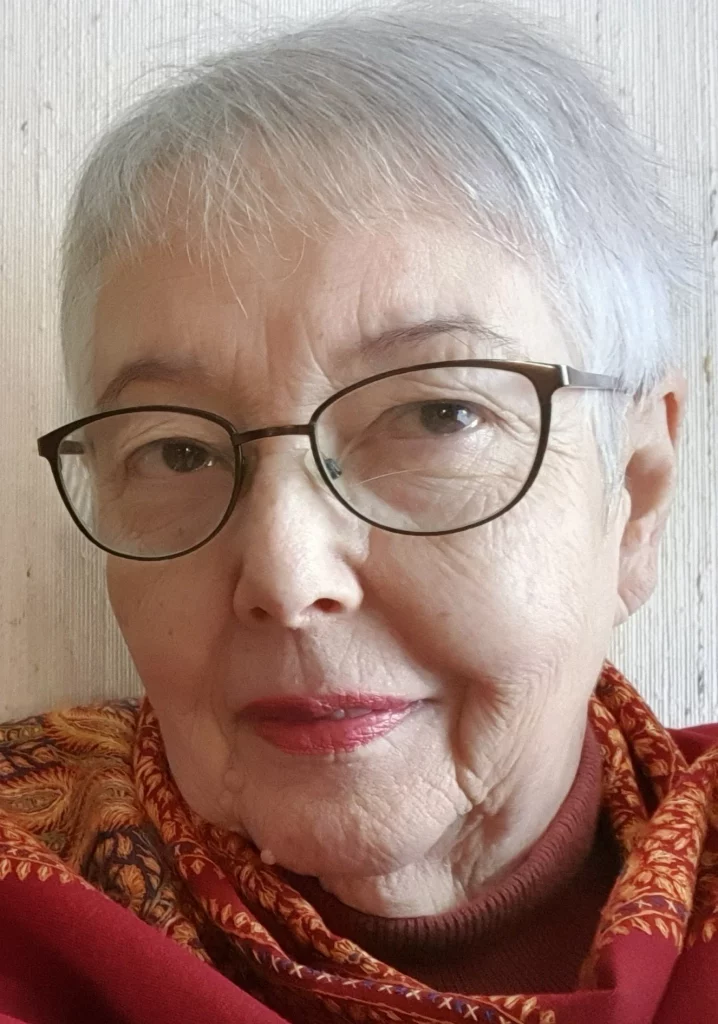
Anita Bose Pfaff
Subhas’s Emilie
While the world has written volumes about Netaji, Anita has been working on a different story. Her forthcoming book, titled Subhas’s Emilie, turns the spotlight towards her mother. If her father’s life was filled with dramatic decisions and political thunder, her mother’s life was marked by patience, courage and immense strength. Anita wants the world to know the woman who stood beside a revolutionary, and then stood alone.
Anita’s book seeks to bring the strength of her mother to the forefront. “It is not only about the few years when she met my father. She lived until she was 85, and there was a whole life before and after that which I am capturing in the book,” says Anita who wishes to bring the feminist aspect into the story.
A life built on her own merit
Anita Bose Pfaff built a formidable academic career. In many ways, her professional journey was the fruit of a disciplined upbringing by a single mother who valued education, self reliance and integrity.
Anita joined the University of Augsburg in Germany in 1971 and went on to become a professor of economics in the Department of Economics and Social Sciences. Over the decades, she taught microeconomics, labour economics and distribution theory, while developing a deep interest in social policy and health economics including Public Health. She helped shape Augsburg’s academic focus on social policy and the socioeconomics of healthcare at a time when the latter area was still evolving within mainstream economics.
Her academic concerns were never abstract. She worked on issues that affected everyday life. Geriatric care, family policy, women’s studies, transfer economics, public finance, demographic change and public health. She believed economics must respond to society, not sit above it.
Her expertise led her to advisory roles at the national level. She served as deputy chair of the Scientific Advisory Board of the German Institute for Economic Research, Berlin. She was co-founder and deputy director of the International Institute for Empirical Social Economics. She also served on the board of the Bavarian Research Association for Public Health and was a member of several scientific advisory bodies.
Beyond the classroom
Between 1989 and 1993, she was part of the Scientific Advisory Board for Women’s Policy at Germany’s Federal Ministry for Youth, Families, Women and Health. She later contributed to the Advisory Board for Spatial Planning at the Federal Ministry for Building and Urban Development and was a member of the German Bundestag’s study commission on demographic change. These roles reflected her commitment to connecting economic theory with social realities, particularly for families, ageing populations and women.
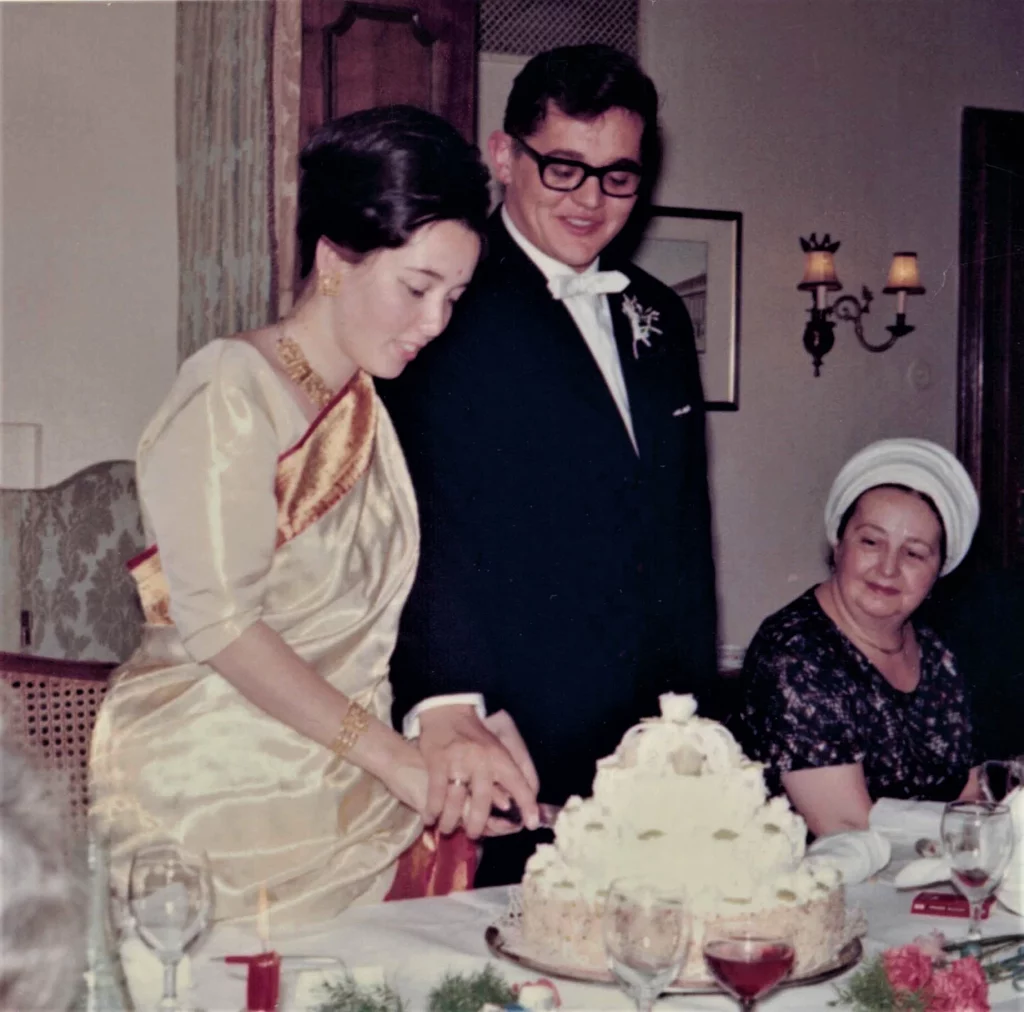
From the archives of Anita Bose Pfaff | Anita Bose Pfaff with Professor Martin Pfaff on their wedding day; Emilie Schenkl (seated)
At the University of Augsburg, she became its first women’s representative beginning in 1989. This was at a time when conversations around gender equity in academia were only beginning to gather force. She helped create structures that would make it easier for women scholars to grow. When she retired in 2008, the university honoured her as its first amica universitatis, a recognition reserved for those professors who have left a lasting imprint.
Activism, awards and fulfilling personal life
Alongside her academic life, she was active in the Social Democratic Party of Germany. Public life and policy engagement were never far from her professional journey. She served as a member of the city council and deputy mayor of her hometown. After retirement she has been a volunteer social worker for the integration of refugees. She is married to Professor Martin Pfaff, a former member of the German Bundestag. They were colleagues at the University of Augsburg and the International Institute for Empirical Social Economics. Together, they raised three children, Peter Arun, Thomas Krishna and Maya Carina. The close relationship with her three children and five grandchildren has been a very important aspect of her life. But she wanted all – a family, a career and social service.
All this was achieved on her own strength, in a country not originally her father’s or her mother’s, and in a field historically dominated by men.
Growing up without Netaji
For all her accomplishments, Anita’s early life was shaped by absence. She was born Anita Schenkl and did not carry her father’s surname at birth. When she was just two months old, Subhas Chandra Bose left Europe on a dangerous submarine journey across three oceans to Southeast Asia, determined to lead the Indian National Army against British rule during the Second World War. In August 1945 came the news of his death following a reported air crash. He was a presence in memory, debate and history, but never in her daily life.
Her awareness of who her father was came gradually. “When India became independent and started having diplomatic representation outside, that was when I became more aware of it,” she mentions adding, “In the process, I think I also came to know that my father was important, but more so when I met other Indians”
His political strategy during the war had involved seeking support from Germany and Japan, which were part of the Axis powers, the military alliance that fought against the Allied nations. After the war ended, Europe looked with suspicion at anyone associated, even indirectly, with that alliance. That complicated reality formed the background of Anita’s childhood.
In Vienna, her mother Emilie raised her alone, with the help of her mother. Post war Austria was struggling economically. Food was scarce. Infrastructure was damaged. Communication was unreliable. Emilie worked shifts at a telephone trunk office to support herself and her daughter. Letters sent to India in 1946 were delayed, lost or never delivered.
Mother–daughter intense bond and its complexity
Looking back, Anita sees not fragility, but resilience. “My mother was working for her own living, which was very important for her,” she remarks. “Reflecting on mother-daughter bonds in general and the relationship with her own mother, she reflects, “On the one hand, mothers and daughters have a very intimate relationship. But at the same time, because they do, their relationship is also difficult.”
Being a single child of a mother who had known solitude, war and loss meant growing up under a watchful and often strict eye, where love was constant but standards uncompromising.
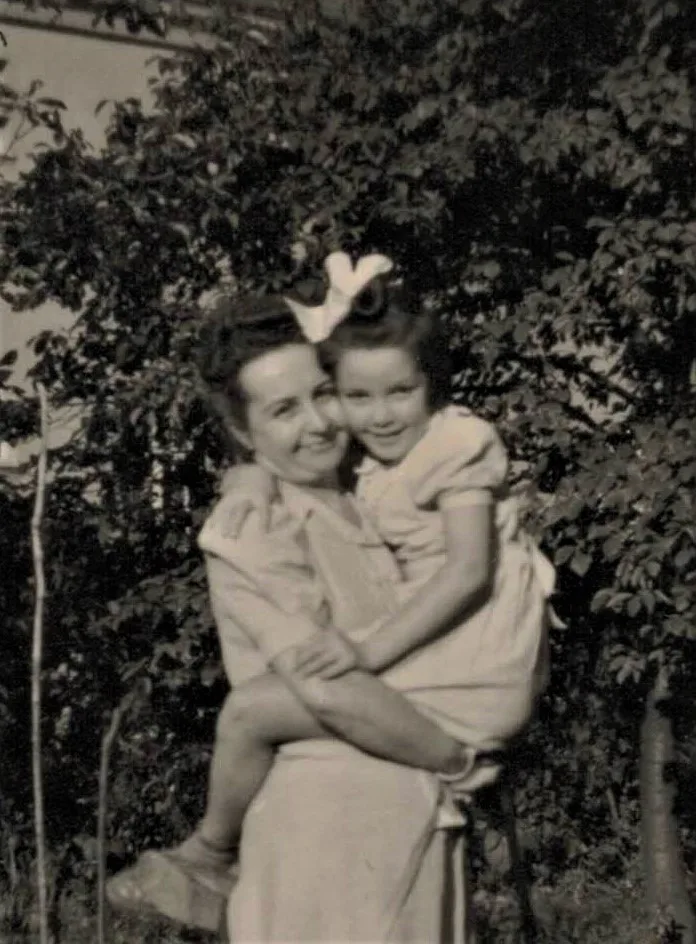
From the archives of Anita Bose Pfaff | Anita with her mother Emilie Schenkl, 1950
Coming closer to her Indian roots
It was only in 1948 that Sarat Chandra Bose, Netaji’s elder brother and a respected nationalist leader in India, travelled to Vienna with his wife Bibhabati and three of their children to meet Anita and Emilie. During that visit, Bibhabati gifted Emilie a set of eight gold bangles. Emilie wore them thereafter. For Anita, that gesture symbolised acceptance, dignity and belonging after years of uncertainty, and still remains etched in her mind.
“I’ve been to India probably 15-20 times. I haven’t really counted,” Anita mentions She first travelled to India in 1960. She remembers many aspects. The faces. The heat. The sense of stepping into a story that was hers, yet unfamiliar. Over time, India became less distant, even though her life remained rooted in the United States of America and since the 1970s in Europe. Bengal of course has been closer to her than the rest of India, When asked about Bengali sweets she smiles, “Bengali sweets are very good, and I like sweets so much.”
Threads of heritage
Another fondness she shares with people in Bengal is for saris. However, she admits that it is not always easy to maintain and manage a sari in Europe, or to find occasions to drape one, but she makes the effort for moments that matter. “Nowadays I wear it sometimes for parties or events. I wore a saree for my last wedding anniversary,” she says with a smile.
Though European, Anita’s mother ensured that her daughter remained connected to her Indian heritage. One such example was teaching her how to drape a sari. “My mother was not a great saree wearer, but she showed me how to wear a saree,” says Anita.
The woman behind the legend
If Anita’s father Subhas Chandra Bose became a towering figure in India’s freedom movement, her mother Emilie Schenkl lived largely outside public memory.
Born in 1910 into an Austrian family, Emilie met Bose in 1934 when he was in Europe working on the book, The Indian Struggle. She joined him as his secretary. They fell in love and married in 1942. Their life together was repeatedly interrupted by political upheaval and exile.
After Bose escaped house arrest in India and eventually reached Berlin, they reunited for a time. Anita was born in 1942. Within months, Bose left again, embarking on his submarine journey to Southeast Asia. Emilie was left in war-torn Europe with an infant.
In the years that followed, she endured economic hardship and social suspicion. Yet she remained steady. She worked. She raised her daughter. She did not seek attention. Anita has been working on the book to trace her mother’s life from pre-war Vienna through the devastation of the Second World War into the difficult decades that followed. The narrative draws on letters, documents and family memories.
Anita Bose Pfaff’s daughter Maya Carina, a marine biologist residing in South Africa, is helping shape the manuscript. Madhuri Bose, granddaughter of Sarat Chandra Bose, who was very close to Emilie, is also contributing. It is, in many ways, a family effort. It also intends to sketch three women’s views of the life of a woman who lived through troubled and radically changing times of history.
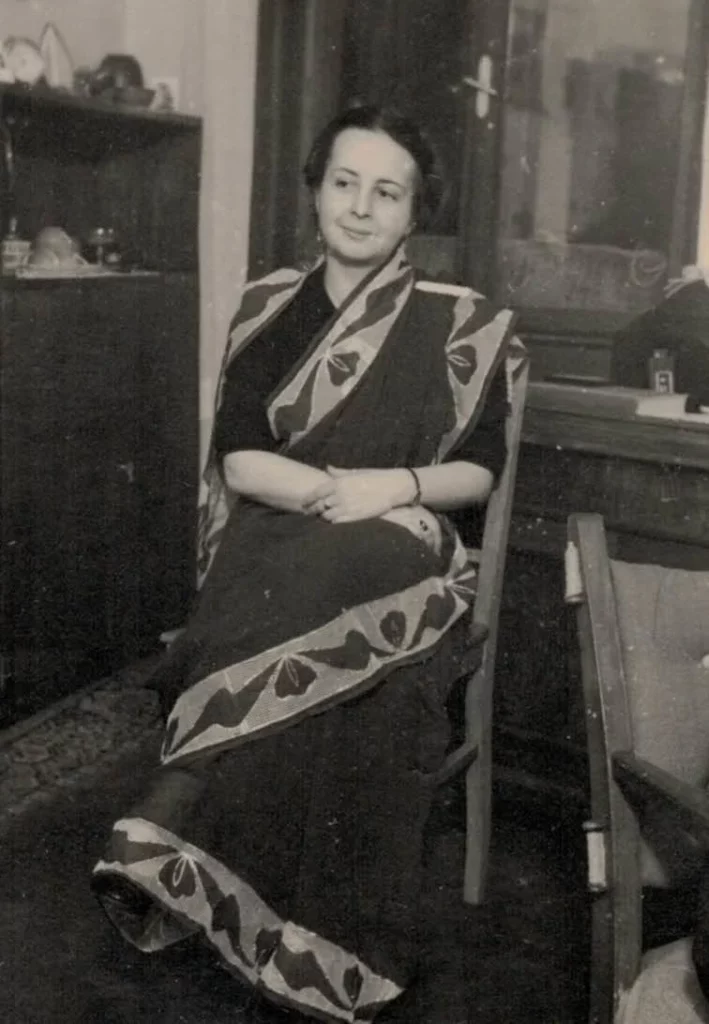
From the archives of Anita Bose Pfaff | Emilie Schenkl, mother of Anita Bose Pfaff, in 1960
A scholar’s lens on women’s changing role
Anita Bose Pfaff carries within her two legacies. One is loud, dramatic and etched into textbooks. The other is quiet, private and resilient. Today, she stands as the careful custodian of her parents’ intertwined histories. Yet she is also an achiever in her own right. A scholar, policy thinker, mother, grandmother and public figure who built her own identity through hard work and conviction.
During her 83 years, she has been a witness, and in her own way a contributor, to the changing role of women in society. “Throughout the world women have had to struggle for equal rights in one way or the other,” says Anita, who has roots across Austria and Germany, India and the United States.
Reflecting on these decades of change, she observes: “Even though these societies differ, they all have in common that women and men do not enjoy equal positions in society, even though formally rights may have become more equal. Yet they are disadvantaged in various ways.”
But she has also seen meaningful transformation. “Almost all countries of the world have achieved progress in the empowerment of women during the years of my life.”
She remains clear-eyed about the road ahead. “Women have to continue to stand up for their rights and their role in society. Very likely this will remain a continuing challenge to women in the future,” she concludes.
ALSO READ: Gurdeep Kaur Chawla: The diplomatic interpreter world leaders trust