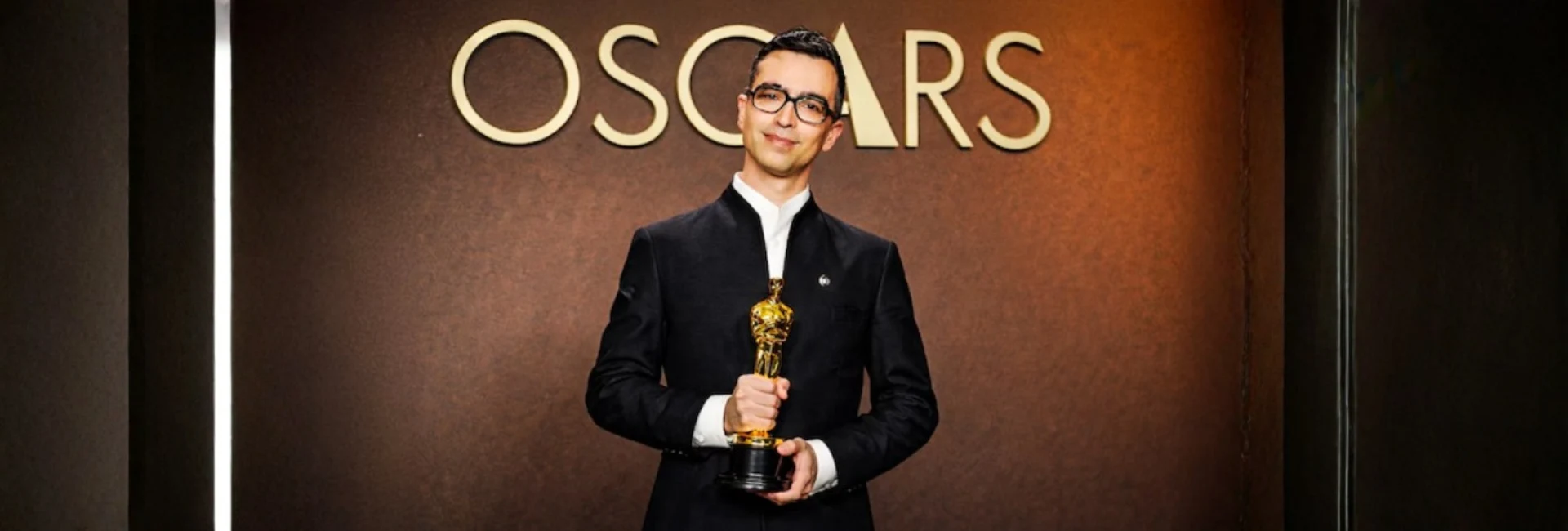


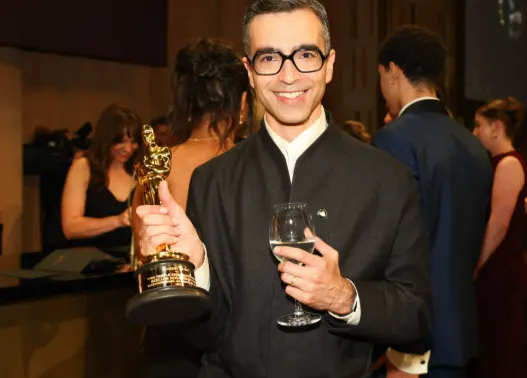
(March 18, 2026) In a rare occurrence at the 98th Academy Awards, the Best Live Action Short Film category ended in a tie, with Two People Exchanging Saliva sharing the honour with The Singers. The French-language short, co-directed by Alexandre Singh and Natalie Musteata, marks a major milestone for the Indian-origin filmmaker whose work spans visual art and cinema.
The United States–France co-production premiered at the 51st Telluride Film Festival in August 2024 before going on to secure one of the night’s most unusual wins. Accepting the award, Singh stressed on his belief in the long arc of artistic impact.
The Oscar speech
During his acceptance speech, Singh spoke about the long-term impact of creative work. “We believe art can change people’s souls. Maybe it takes 10 years’ time, but we can change society through art, through creativity, through theatre and ballet, and cinema,” he said.
The win places Singh among a small group of Indian-origin filmmakers recognised at the Oscars, while also marking a milestone in a career that has moved across disciplines, from visual art to cinema.
A dystopian story of intimacy and control
Two People Exchanging Saliva is set in a dystopian world where intimacy is criminalised. Kissing is punishable by death, and people actively avoid brushing their teeth, consuming garlic to deter attraction.
The story follows Malaise, a young department store employee, and Angine, a wealthy customer who develops feelings for her. Over nine days, their connection deepens within a society that strictly polices desire.
Malaise secretly buys a toothbrush and toothpaste from the black market in an act that signals both rebellion and danger. When her manager falsely accuses her of attempted assault and kissing, Malaise is arrested and executed. Angine, arriving too late, discovers her body among others punished for similar transgressions. A final flashback reveals a missed opportunity for connection, reinforcing the film’s exploration of repression and consequence.
A cross-cultural upbringing shaped by migration
Filmmaker Alexandre Singh was born in Bordeaux, France, in 1980, into a family shaped by migration. His father had moved from Punjab to the United Kingdom in the 1960s, part of an early wave of Indian immigrants navigating a difficult social landscape. Singh has described that journey in stark terms: “In the 1960s, my father left Punjab to come to the United Kingdom with a beard and a turban… it was very difficult for him.”
Over time, his father pursued higher education, earning a BA, MSc and PhD and adapted to his surroundings. The visible markers of identity changed, but not entirely the internal ones. As Singh recalled, “He was so proud to be an Indian.”
He later married a French woman, and Alexandre Singh grew up at the intersection of Indian, British, and French cultures.
Loss, identity, and distance from heritage
The filmmaker lost his father at the age of 21, a moment that shaped his understanding of identity and belonging. He has said that the loss also meant losing a deeper connection to his heritage.
“It pains me that in some ways I lost my connection to my heritage, that true connection,” he shared, reflecting on the absence that followed. This distance between inheritance and understanding forms an undercurrent in how he speaks about his life and work.
Choosing art against expectation
Alexandre Singh studied fine arts at the University of Oxford’s Ruskin School of Drawing and Fine Art before pursuing an MFA at the School of Visual Arts in New York.
His decision to pursue art came with tension at home. He has described the moment he was accepted into art school as deeply conflicted. It was personally significant, but difficult for his father to accept. For a parent shaped by an immigrant’s emphasis on stability, the choice of art was, as Singh put it, “an abomination.”
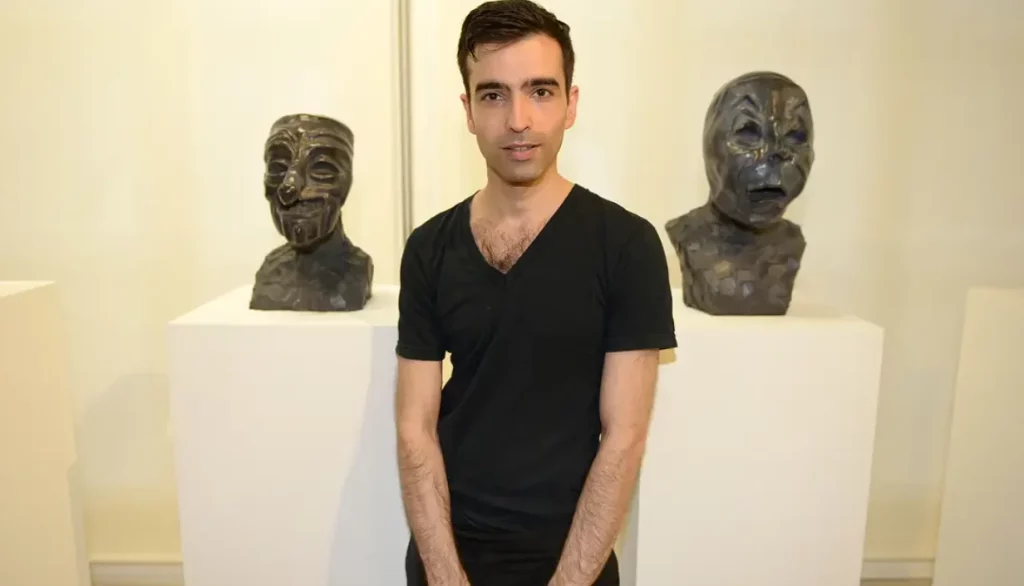
Alexandre Singh at one of the art exhibitions
A foundation in visual art
Before moving into filmmaking, Singh established himself in the visual arts, with exhibitions across New York, Paris, Berlin, and London. His work has been shown at institutions such as the Guggenheim Museum and the Museum of Modern Art, alongside numerous solo exhibitions in major galleries. This background informs his cinematic language, where narrative and visual experimentation intersect.
Approaching the short film form
He has spoken about the way he approaches storytelling in short films, resisting the idea that brevity requires speed. There’s a temptation in a short film to accelerate the storytelling,” he noted. Instead, he likens the structure to an accordion by expanding and compressing rhythmically.
He has also questioned the industry’s tendency to treat short films as stepping stones. “In America, there’s this expectation that short films are always a stepping stone… I think that’s unhealthy,” he said. For him, the short film remains a complete form that allows for controlled pacing and layered storytelling.
An evolving creative journey
Before his Oscar-winning project, Alexandre Singh directed short films such as The Appointment (2019) and Plan Large (2016), both of which explored unconventional narrative structures. His transition from visual art to filmmaking reflects a broader shift in medium, but not in intent, continuing to explore how stories unfold through time, space, and perception.
With Two People Exchanging Saliva, that approach has now reached one of cinema’s biggest stages, marking a moment that connects personal history, artistic practice, and global recognition.
Indian and Indian-origin Oscar winners
From a historic first win in the 1980s to recent victories in music, documentaries, and short films, Indian and Indian-origin talent has steadily expanded its presence at the Academy Awards. The journey reflects not just individual excellence, but the widening influence of Indian storytelling across global cinema. Here is every milestone, in order:
-
Bhanu Athaiya (1983) – Best Costume Design, Gandhi
First Indian Oscar winner, setting a historic milestone for Indian cinema on the global stage. -
Satyajit Ray (1992) – Honorary Academy Award
Legendary Indian filmmaker honoured for his extraordinary contribution to world cinema, accepting the award from his hospital bed shortly before his passing. -
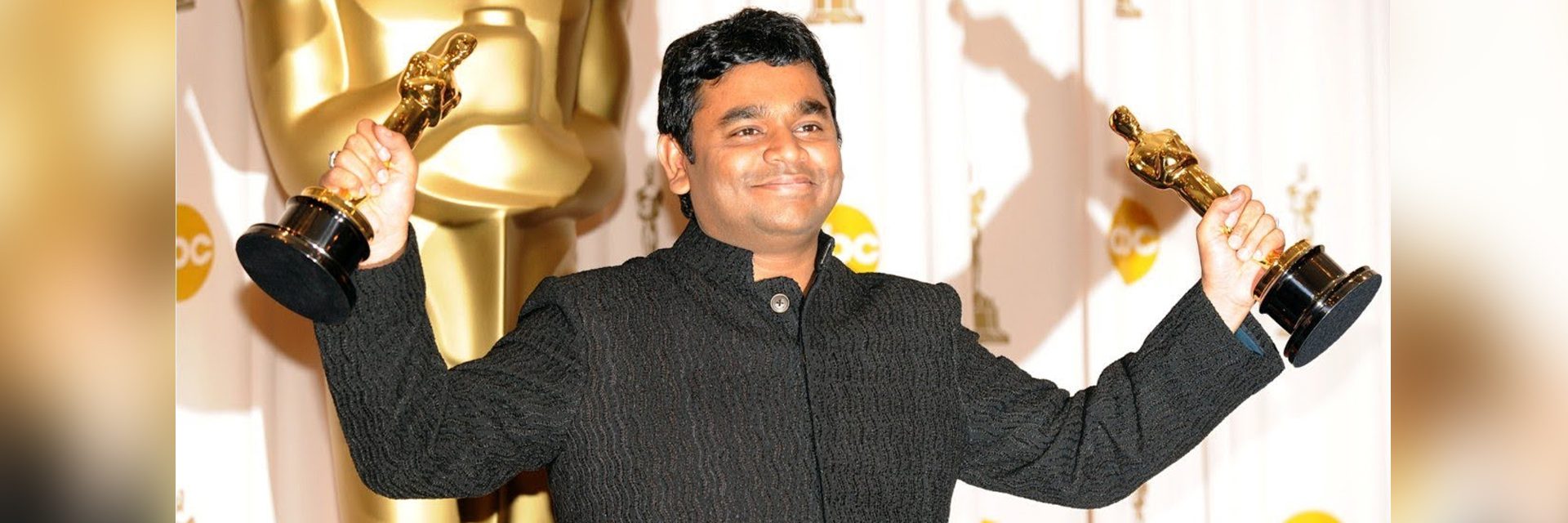
A.R. Rahman (2009) – Best Original Score & Best Original Song, Slumdog Millionaire
Became the first Indian to win two Oscars in one night, bringing global recognition to Indian music. -
Gulzar (2009) – Best Original Song, Slumdog Millionaire
Shared the Oscar for “Jai Ho,” marking a rare moment of Indian lyricism being recognised globally. -
Resul Pookutty (2009) – Best Sound Mixing, Slumdog Millionaire
Elevated India’s presence in technical cinema, winning for his work in sound design. -
Asif Kapadia (2016) – Best Documentary Feature, Amy
British-Indian filmmaker recognised for his distinctive archival storytelling style in global documentaries. -
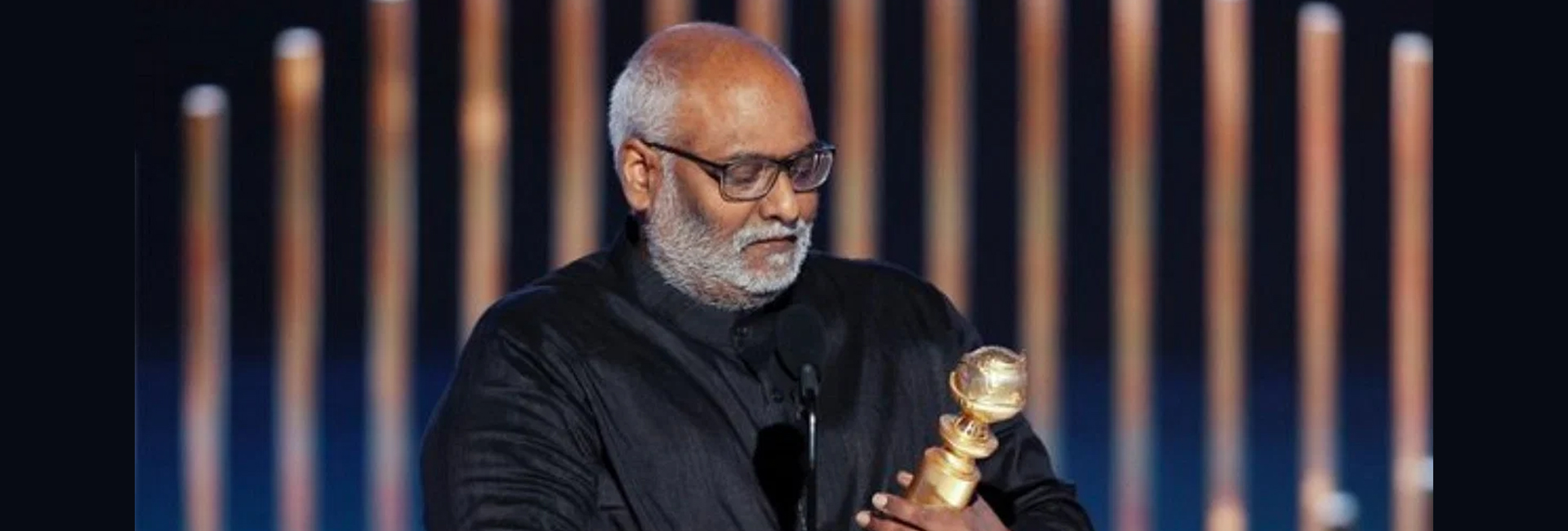
M.M. Keeravaani & Chandrabose (2023) – Best Original Song, RRR
“Naatu Naatu” became the first song from an Indian film to win an Oscar, gaining worldwide popularity. -
Guneet Monga & Kartiki Gonsalves (2023) – Best Documentary Short Film, The Elephant Whisperers
Marked India’s first win in this category, spotlighting indigenous storytelling and conservation. -
Namit Malhotra & DNEG (2011–2025) – Best Visual Effects, multiple wins
Indian-led VFX studio behind several Oscar-winning films, with recognition awarded institutionally to DNEG. -
Alexandre Singh (2026) – Best Live Action Short Film (tied), Two People Exchanging Saliva
Franco-Indian filmmaker whose experimental narrative brought diaspora storytelling to the Oscars stage in a rare tie.
ALSO READ: From Garage Startup to Hollywood’s VFX Titan: Namit Malhotra leads DNEG to its 8th Oscar