(December 30, 2025) There was no shortage of diaspora political wins in 2025. From council chambers to parliaments; Indian-origin political leaders proved how the diaspora is firmly woven into the civic mainstream of many countries. But a few victories carried an extra charge. These wins weren’t just about margins or mandates. They were about return (Kamla Persad-Bissessar), visibility at the highest table (Anita Anand), identity paired with immediate policy delivery (JJ Singh), and a new civic imagination (Zohran Mamdani). Many other diaspora leaders won too but these names stood out for the scale of their victories and the offices they were elected to. Global Indian tracked these wins as they unfolded. Here’s a look back.
Kamla Persad-Bissessar: Elected as Prime Minister of Trinidad and Tobago
Kamla Persad-Bissessar’s 2025 return to power as Prime Minister of Trinidad and Tobago landed as more than a political comeback; it felt like a diaspora arc completed. Her story reaches back to 1889, when her great-grandfather, Pandit Ram Lakhan Mishra, left Bihar as an indentured labourer and arrived in the Caribbean under Britain’s contract system. Generations later, she became the first woman Prime Minister of Trinidad and Tobago, holding office from 2010 to 2015. Among the earliest women of Indian descent to lead a country outside the subcontinent, she made headlines again with her return to the prime minister’s office in 2025.
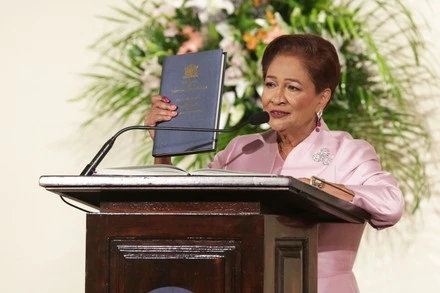
Kamla Persad Bissessar during her swearing-in ceremony
Born in Siparia into a Brahmin Hindu family, Persad-Bissessar’s early life was shaped by modest means and formidable women. Her mother worked as a domestic labourer and in cocoa fields before saving enough to run a small roti shop, while her grandmothers anchored community prayer groups and mentored women through local initiatives. Kamla has often credited these women as her first lessons in courage and independence.
Education became her launchpad. She left for London at 17, later studied at the University of the West Indies, and pivoted to law, graduating top of her class at Hugh Wooding Law School. Entering politics in 1987, she rose steadily from local government to MP, senator, and Attorney General, before leading the UNC to power in 2010. A decade later, her 2025 victory reaffirmed both political stamina and a lineage once defined by displacement, now expressed as national leadership. Read More
Anita Anand: Elected as Minister of Foreign Affairs, Canada
In the spring of 2025, Anita Anand raised her right hand, placed the other on a copy of the Bhagavad Gita, and took the oath as Canada’s new Minister of Foreign Affairs, becoming the first Hindu to hold the role. The moment, staged in the grandeur of Rideau Hall, was seismic: a senior global-diplomacy portfolio marked by a visible, unapologetic expression of faith and heritage.
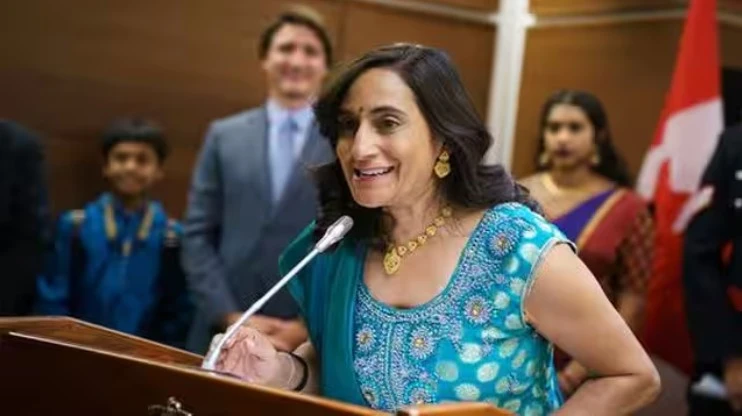
Anita Anand during a diaspora event
Anand’s journey began far from Ottawa’s power corridors. Born in 1967 in Kentville, Nova Scotia, a small town where her family was among the few Indian-origin households, she grew up watching her parents serve the community as doctors. Her father, S.V. Anand, came from Tamil Nadu and worked as a general surgeon; her mother, Saroj D. Ram, hailed from Punjab and worked as an anesthesiologist. That early lesson in “giving back” became her compass.
After moving to Ontario, Anand built a formidable academic life — political studies at Queen’s University (where she graduated as a gold medallist), law at Oxford, and further legal training in Canada followed by a distinguished career as a governance scholar teaching at leading universities. Elected as MP for Oakville in 2019, she entered cabinet immediately, overseeing pandemic-era procurement and vaccine acquisition. She later became Minister of National Defence, another barrier-breaking appointment, before handling the Treasury Board and Transport portfolios. In 2025, under Prime Minister Mark Carney, foreign affairs became her defining stage. Read More
JJ Singh: Elected to the Virginia House of Delegates, USA
JJ Singh’s 2025 rise offered a diaspora story where representation arrived with results. A Harvard-educated economist, real estate entrepreneur, and former White House policy advisor, Singh made history as the first turbaned Sikh ever elected to the Virginia House of Delegates. He quickly moved from symbolism to outcomes. In his first term representing Virginia’s 26th District, he helped secure $55 million in tuition relief, delivering a major promise within months and placing college affordability at the centre of his public identity.
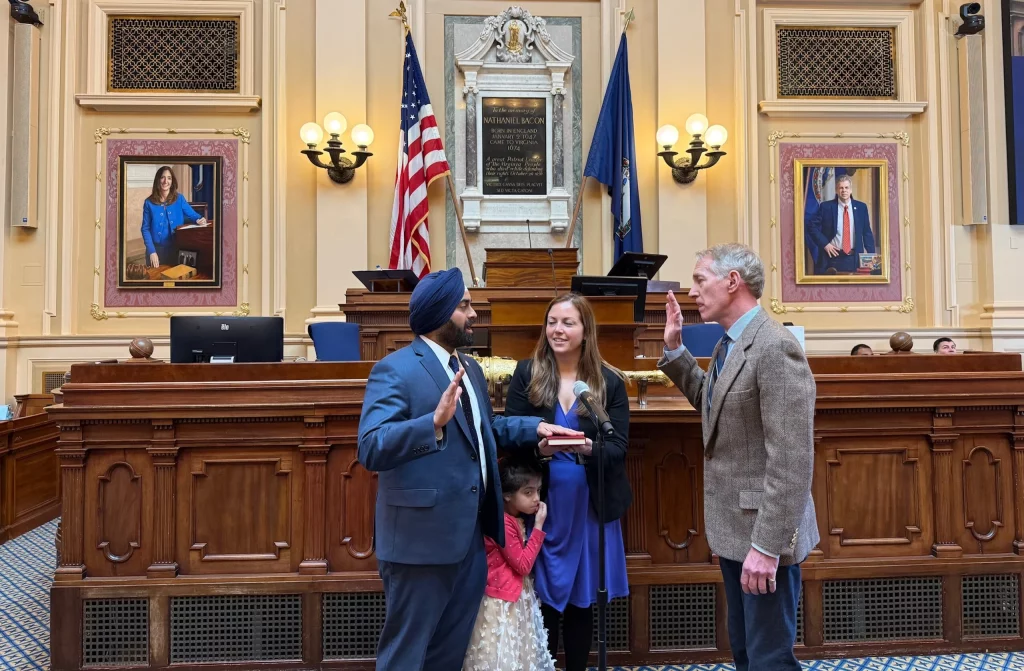
JJ Singh during his swearing-in ceremony
Singh’s biography is shaped by immigrant grit. His parents arrived from India in 1970 with little financial stability, studied by day, worked by night, and later dedicated their careers to serving U.S. veterans at the Department of Veterans Affairs. Raised in Fairfax Station, Singh absorbed their ethic of perseverance and public service.
After earning an Economics degree from the University of Virginia, he joined the Peace Corps in Bolivia, becoming the first turbaned Sikh to serve, working with single mothers to access microloans and build small businesses. He later earned an MBA and MPA from Harvard, served in the Obama administration’s Office of Management and Budget, and advised Senator Chris Coons on economic policy. In Richmond, he has also been vocal on gun violence prevention, reproductive freedom, and pragmatic growth, presenting a model of diaspora leadership that is both historic and relentlessly practical. Read More
Zohran Mamdani: Elected as Mayor of New York City, USA
Zohran Mamdani’s 2025 New York City mayoral win played like a cultural and political crossover — part street movement, part immigrant milestone, part Bollywood finale. On election night, his first victory speech ended with Dhoom Machale blasting through the venue, a wink to a campaign that leaned into joy, identity, and storytelling without losing ideological edge. At 34, Mamdani became the youngest and first South Asian and Indian-American to be elected as mayor of NYC, defeating heavyweight rivals including former Governor Andrew Cuomo and Republican nominee Curtis Sliwa.
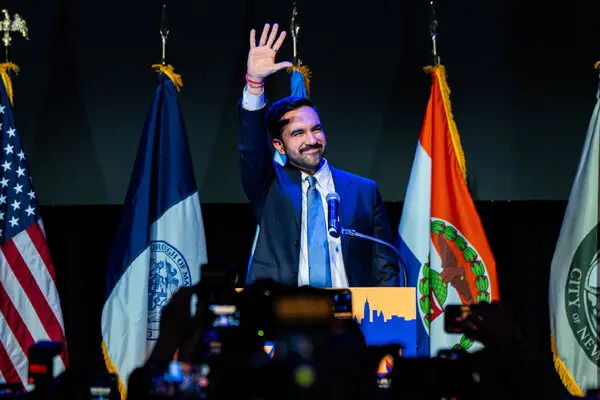
Zohran Mamdani while addressing the crowd moments after his win
Born in Kampala in 1991, Mamdani’s worldview is built from migration and memory. His parents, filmmaker Mira Nair and academic Mahmood Mamdani, embody art and scholarship, and his politics often fuses both — emotionally literate, culturally fluent, and policy-driven. His viral Deewar riff captured the tone: when power says “I have everything,” Mamdani answered with “Aap” — you, the people, turning politics into a shared project rather than a lecture.
Before City Hall, he worked closely with families in crisis as a foreclosure prevention counselor. As a New York State Assembly member, he carried activism into governance joining taxi drivers on hunger strike and pushing transit affordability through his “Fix the MTA” campaign, translating protest into policy. In 2025, small-donor energy and volunteer grit powered his run. His win wasn’t only electoral; it was symbolic as an immigrant city chose a leader who makes its people feel seen, heard, and fully part of the story. Mamdani’s mayoralty will begin at midnight on January 1, 2026. Read More
In 2025, the diaspora asserted confidence to lead visibly, to govern decisively, and to reimagine power without shedding identity. Taken together, these four wins captured how Indian-origin leaders are no longer navigating the margins of political life abroad, but actively reshaping its centre through comeback politics, cabinet-level authority, rapid policy execution, and movement-driven imagination.