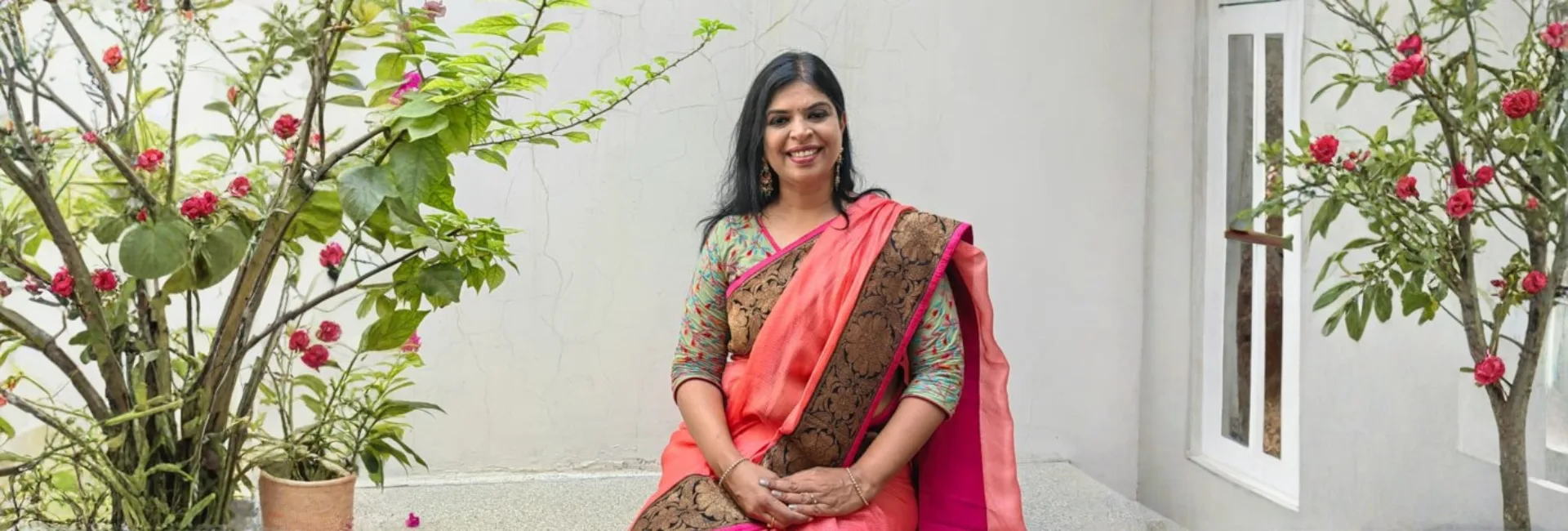


(March 9, 2026) If someone had told Kalpana Ramesh 20 years ago that she would become a water conservationist, she would have laughed it off. The interior-designer and architect was leading a happy, comfortable life abroad — seven years in the US and two years in Singapore before moving back to India in the year 2000.
Living in Hyderabad, Kalpana’s family was dependent on purchased water which came in tankers. One day, she followed the tankers to their source — only to discover that the tankers were drawing water from questionable, even polluted locations. Alarmingly, tests even revealed contamination, including E.coli.
Eventually, a successful experiment with rain water harvesting ended up with Kalpana turning a water conservationist. “Our population, often seen as a burden — is our strength. Even if 40 percent of us act responsibly by harvesting rainwater, restoring lakes, rationalising consumption — we can avert a major water crisis which otherwise seems inevitable by 2030,” says Kalpana Ramesh, Founder of The Rainwater Project, in conversation with Global Indian.
Featured in ‘Mann Ki Baat’ by Prime Minister Narendra Modi and selected among seven women to take over the PM’s social media handles on Women’s Day 2020 — Kalpana has proved her mettle in achieving rain water harvesting, lake revivals and 13 stepwell restorations in the Telangana region by working in tandem with the state government.
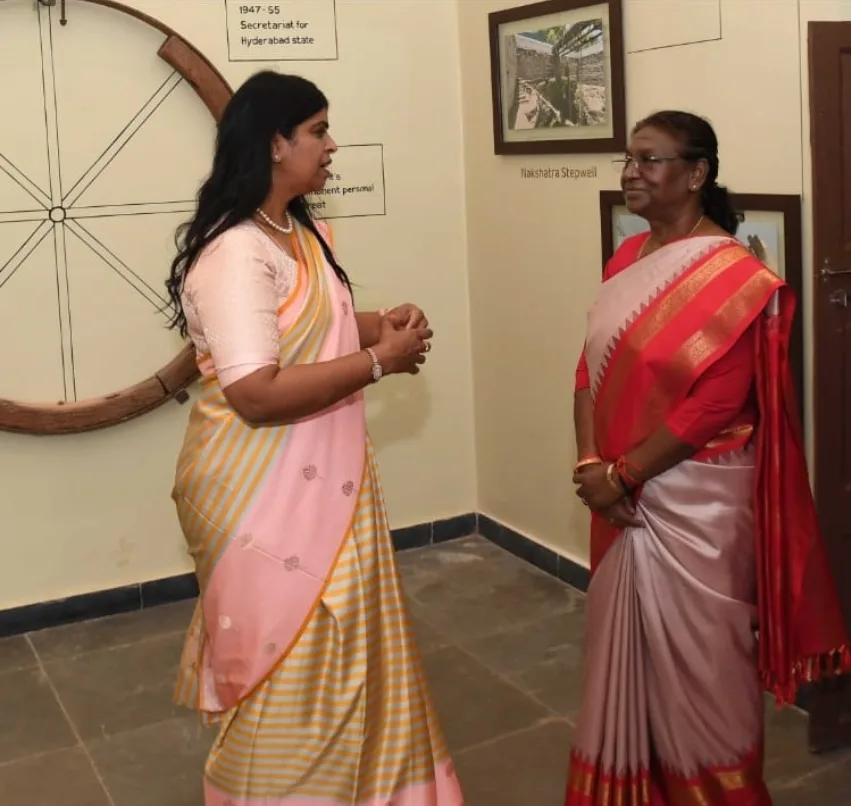
Kalpana Ramesh with President Droupadi Murmu
Bansilalpet restoration
One of the many highlights of Kalpana’s journey has been the restoration of the Bansilalpet stepwell in Hyderabad in 2022. The well was part of a garden before British Resident TH Keyes set up the Bansilalpet model village around it, funded by Seth Bansilal in 1933. Over the past four decades, the well, which has a storage capacity of 22 lakh litres of water, was left in ruins, filled with 2,000 tonnes of waste.
Along with 100 professionals and 1,000 workers, Kalpana took up the major project, cleaned and de-silted the stepwell. In a span of 500 days, the four-decade-old stepwell was restored to its original glory. “The restoration was transformative. What was once a dump yard became a heritage asset,” informs Kalpana.
Through crowdfunding, government collaboration, and a three-time matching grant, Kalpana and team not only developed the well but its entire precinct. It is now surrounded by a pathway with electrical light poles, a plaza, an interpretation centre, an amphitheatre, a jogging track and a garden.
Big 5 Construction Impact Awards
The Bansilalpet stepwell restoration project bagged the “Sustainability Initiative of the Year 2022” award at the Big 5 Construction Impact Awards ceremony hosted by UAE’s Ministry of Energy and Infrastructure in Dubai in December 2022. “It was a great achievement for Telangana Government and enterprises like us,” says Kalpana.
Big 5 is the largest and most influential construction event in the Middle East, Africa and South Asia. It supports the UAE’s goal of achieving net-zero emissions by 2050 and the growth of the circular economy in the region and beyond.
The Rainwater Project
Kalpana spearheads the initiatives through her social enterprise, The Rainwater Project, that provides integrated water solutions. She devised and advocated a tripartite model involving Community, Government and NGO to achieve sustainable goals.
After 23 years in design practice, she transitioned fully into water conservation through her social enterprise. Her team includes architects, urban planners, geologists, and watershed experts. “We have restored over 30 wells and stepwells. We create low-maintenance, modular rainwater systems — not just traditional pits,” says Kalpana who was featured in UN Women 75 transformative stories.
Along with her team, Kalpana also maps ground aquifers to understand water situation in a ‘natural phyto approach’, or in other words, a ground upwards approach, to optimise groundwater resource management.
View this post on Instagram
Early years in Bangalore
Born in Bangalore, Kalpana has fond memories of her mother, whom she describes as the anchor of her life and her two sisters. “My father was deeply involved in his businesses — he would leave home at 6 a.m. and return only by 10:30 or 11 at night. We would often wait for him, but most days we were asleep before he came home.”
Raised to be independent
Her mother raised them with one unwavering belief — to grow into independent professionals. Education, she would say, is not about degrees — it is about absorbing knowledge and understanding what you learn. “She constantly reminded us that as daughters we must stand on our own feet, never dependent on anyone — not even after marriage. She instilled this in us from the time we were in primary school.”
Discovering a passion for architecture
As a student, Kalpana was ambitious and focused. She even prepared for medicine because she loved the idea of wearing a white coat. “I simultaneously prepared for engineering (which was required for architecture then) and medical entrance exams.”
When she secured a medical seat in another city, Kalpana’s parents were hesitant to send her, so she chose architecture in Bengaluru. “I fell in love with it,” smiles the water conservationist, who studied at BMS College of Engineering and completed her schooling from Goodwills Girls High School. Colours always fascinated Kalpana. “That love for colour eventually guided me towards architecture and later interior design,” she remarks.
Connect with water
Kalpana’s mother also had a deep love for nature. “I still remember the mango tree she cared for so lovingly. My father too would spend weekends gardening — we had nearly 30 rose bushes in our garden, always in bloom. I would pluck petals and play with their colours.”The family home faced Ulsoor Lake in Bangalore. “I grew up walking along the lake to school and college, watching regattas, feeling deeply connected to water and landscape,” recalls Kalpana, who never imagined that lakes and water bodies would define her life’s work later on.
Life in Hyderabad
After living in the US and Singapore, Kalpana wanted to return to Bengaluru, but chose Hyderabad instead, due to her husband’s work. “We lived in four different localities in the city, where water tankers were a way of life.”
Over a period of time, Kalpana became concerned about the quality of water, so much so that she began researching tanker water. Following water tankers to their source, she discovered that municipal water had high chlorine levels.
“That’s when I realised that clean water is not always safe water. The answer, I discovered, was rainwater,” says the water warrior, who has led initiatives like Save 10K bores, Live the Lakes ‘and Blue Hyderabad, aimed at creating awareness and increasing civic & moral responsibility towards protecting water, its sources and restoring them to their former glory.
Water wisdom
Drawing from traditional water wisdom — the stepwells of Rajasthan and Gujarat, underground tanks in havelis — Kalpana understood that rainwater harvesting was not new, it was forgotten knowledge. When she built her own home in the Gachibowli area of Hyderabad, Kalpana finally had the chance to experiment. The first thing she built was a 25,000-litre sump under an open courtyard.
“Every drop of rainwater was directed into it through simple sand and charcoal filtration. The result? We became tanker-free,” smiles Kalpana, reminding that rainfall in Hyderabad is spread across nearly eight months — not just two, as commonly believed.
From a 1,000 sq ft rooftop, she could harvest over one lakh litres annually. “We drank it, cooked with it and washed clothes. The water was soft, clean and required only UV filtration. Suddenly, we moved from scarcity to abundance. That transformation marked the beginning of my water journey.”
From awareness to action
By 2016, when Hyderabad faced severe water stress, Kalpana’s colony had water security. “While neighbouring communities rationed water, we were stable. That was my turning point. If one home could change, why not a colony? If a colony could change, why not a city?”
For nearly a decade, Kalpana conducted awareness sessions, spoke to communities, schools, corporates — reaching over two lakh people. “But only 2 percent converted awareness into action. That frustrated me, so I shifted strategy,” says Kalpana, an active member of the Hyderabad Design Forum (HDF), which is documenting the forgotten stepwells of Telangana.
Instead of only awareness, she moved towards enterprise and execution. “With my architectural background, I integrated water resilience into design projects — homes, offices, hotels, industries.”
Real reward
Since then, recognition has followed. Kalpana’s enterprise partnered on AMRUT 2.0 projects with the Ministry of Housing and Urban Affairs, and implemented the Shallow Aquifer Management (SAM) project across five Hyderabad parks — making them water positive and reducing urban flooding.
Kalpana received the Swachh Sujal Samman Award, Jal Hero recognition and State awards for heritage water restoration besides National design awards for conservation and civic design. Among her most prestigious projects was restoring wells at the Rashtrapati Nilayam.
But the real reward? “When 400 people walk around a restored lake. When 3,000 residents benefit and children play by water without stink or mosquitoes. The success was when communities felt proud again,” says Kalpana, who drawing attention to the looming “water wars” and predictions that 50% of India may face severe water stress by 2030.
Encouraging women
Armed with viable solutions and a never-say-never attitude, Kalpana worked with a predominantly male workforce and encouraged many more women to join her and support the restoration projects.
Her daily work involves meetings with government officials, community sessions, funding proposals, site visits to lakes and stepwells. “Limited representation of women in governance and decision making poses a challenge,” points out Kalpana, who no longer gives “awareness-only” talks unless a school or institution commits to rainwater harvesting.
Kathak at 50
Family remains central to Kalpana’s life. “I am now a grandmother to a three-year-old,” smiles Kalpana, who loves cooking, travel, and food. “I learned Kathak at 50,” informs Kalpana, who grows nearly 30–50 percent of her own food through terrace and farm cultivation.
For her, design today is inseparable from sustainability. “If it is not circular, resource-conscious, and environmentally responsible — it has no meaning,” feels Kalpana, a TeDx speaker, who firmly believes that a water-secure future is achievable.
- Follow Kalpana Ramesh on LinkedIn and Instagram
- To learn more about The Rainwater Project, visit its website
ALSO READ: Amazon conservationist Shaji Thomas rows deep into forests to help tribes