


(March 8, 2026) Sonia Agarwal Bajaj always had access to high-quality education, both in India and abroad. An alumna of Dhirubhai Ambani International School in Mumbai and Babson College in the US, besides two renowned institutions in Milan, Italy, she deeply values her learning experiences and how they transformed her life.
But when she moved to a tier-two city like Agra from Mumbai after her marriage, she realised that children did not have access to quality education. She quickly analysed the gaps in the education system and came up with a blueprint based on her rich educational experiences.
Eventually, it led to the birth of Little Future Founders, aimed at improving financial literacy among children, which currently stands at just seven per cent in India — and Little Chipper International Preschool, which focuses on making high-quality education accessible.
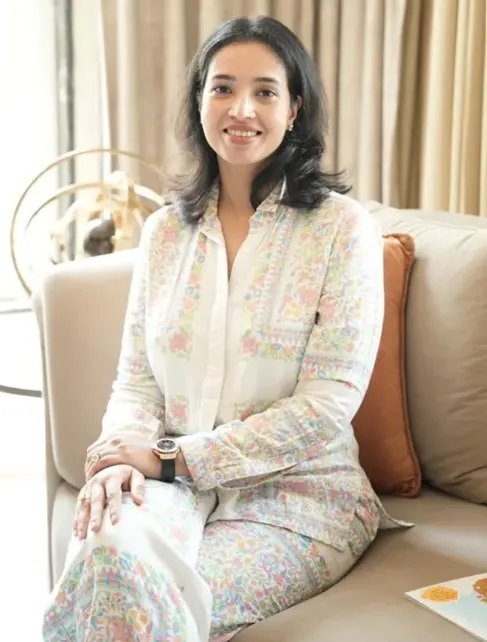
“Children are naturally curious learners who need to be given the right environment and direction to further their own learning,” says Sonia Agarwal Bajaj, an award-winning educationist and the founder of the two institutions, in a chat with Global Indian.
While Little Future Founders is on a mission to make more and more children financially literate, Little Chipper, which was awarded the No.1 rank for Outstanding Leadership in the Education World Grand Jury India Preschool Rankings 2020–21, is bringing out the best in young learners.
Building financial literacy early
Globally, only one in three individuals is financially literate. “Little Future Founders is on a mission to change that,” says Sonia, highlighting the need to empower the next generation with financial literacy, which she believes is a must-have skill for every individual.
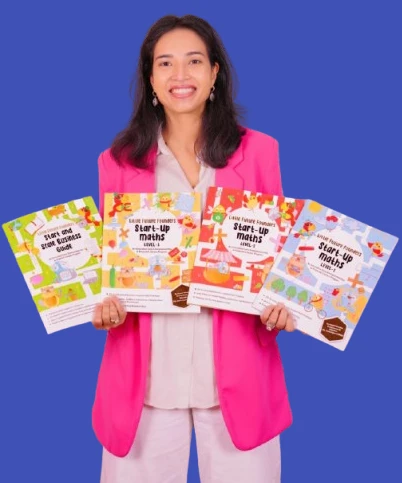
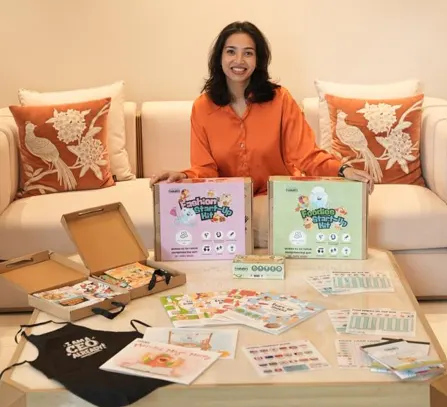
She says her books, kits, games, and programmes are designed in such a way that children can easily relate to and understand the subject. “It helps children explore introductory concepts in financial literacy, supply and demand, while also discovering 20+ business ideas.”
Creating a healthy relationship with money
Sonia says financial literacy allows children to develop a healthy relationship with money and practise simple personal finance techniques. “It exposes children to early entrepreneurship, helping them develop an action-oriented mindset and become more creative, innovative, resourceful, and better problem-solvers.”
Her books and guides use mathematics to introduce core business concepts in areas such as sales, marketing, operations, finance, and costing. “The business guides help children navigate their inner calling and provide a step-by-step journey into starting and scaling their business,” says the renowned educationist, pointing out that equipping children with financial literacy skills enables them to pursue any field of work, including entrepreneurship.
Making quality preschool education accessible
Sonia says Little Chipper was born out of a deep desire to make an impact in the city and make high-quality education accessible in a place where it was previously lacking.
She explains that the International Early Years Curriculum (IEYC) offered by Little Chipper International is a globally recognised, scientifically designed curriculum for children below the age of six.
The curriculum is carefully designed to foster a love for learning and is based on four main learning strands — Independence & Interdependence, Communicating, Enquiring, and Healthy Living & Physical Well-being. “Almost 90 per cent of a child’s brain development happens before the age of six,” points out Sonia, highlighting that rich learning experiences in the earliest years provide lifelong benefits for learning, behaviour, and both physical and mental health.
Inspired by the Reggio Emilia approach
She believes that children learn best through rich experiences rather than structured activities. “Inspired by the Reggio Emilia approach, exploration and play are central to our educational philosophy. We make our toddlers active participants in their own learning and give them the choice to pick their preferred style of learning.”
IEYC is officially affiliated with and echoes the 16 sustainability goals identified by the United Nations. “We believe that our future leaders must be aware, passionate problem-solvers who have a leadership mindset. Our curriculum and our method of implementation help us instil these values in our future changemakers.”
Using technology to scale learning
While Little Chipper International was creating a profound impact for children in the city, Sonia was looking to expand her vision further. That’s where Whiz League came in. “With Whiz League, we were trying to use technology to create capacity-building and make education at scale possible.”
A digital learning run
Before COVID, Sonia had launched masterclasses with Indian celebrities and experts to produce masterclass content in areas such as culinary arts, performing arts, fashion, and other skill-based domains. “With more than 75,000 paid users and one and a half lakh learning sessions that took place on the Whiz League platform, it definitely had a strong run.”
Growing up in Mumbai
Born in Mumbai in a large joint Marwari family, Sonia went to Dhirubhai Ambani International School. “In my childhood, I was always encouraged to try new things and explore different sports.”
Sonia’s parents never cared as much about grades as they did about her understanding and application of knowledge. She never had tuition teachers but instead had experts from different fields come to speak and interact with her on a variety of topics. “Those learning experiences shaped me for life,” says Sonia, for whom playing board games with cousins was also part of learning.= She was just 14 when she did her first internship as a junior market researcher with American firm AC Nielsen — a pioneer in market research.
Studying entrepreneurship in the US
In 2008, Sonia went to Babson College in the US to pursue a Bachelor’s degree in Business Administration (BBA), specialising in Strategic Management and Marketing.
“Babson helped me demystify the world of entrepreneurship and made me realise it’s just about breaking things down into smaller elements, getting started, doing what is possible, pivoting, and trying again.”
Learning to think like an entrepreneur
The course helped evolve her mindset while enabling her to work and collaborate with people from different experiences, backgrounds, temperaments, and skill sets.
She says there were two programmes in particular that shaped her journey. One was the FME programme in her first year, where students were allowed to start their own businesses in groups of 30, and the second was with Professor Len Green, modelled around the apprentice format.
“I look back on my learning strongly from that class,” says Sonia, who was acknowledged as one of the Top 50 Most Innovative Student Entrepreneurs Worldwide by the Kairos Society, a US-based student-run non-profit foundation. She says Babson turned out to be lucky for her in more ways than one, as she met her future husband Danish there.
Paris, Milan and the WHITENIFE Venture
Sonia went on to pursue a diploma in Luxury Brand Management from Istituto Marangoni in Paris and also studied Fashion Marketing and Economics at Università Bocconi in Milan, Italy.
“For the longest time, I thought I would stay in the retail space,” she says. Before graduating from college, she launched a company called WHITENIFE, one of Asia’s earliest marketplaces for sustainable and ethical fashion products.
“We were way ahead of our time. The year was 2012, when Jabong and Myntra had just started taking shape.” While running WHITENIFE, Sonia had also co-founded another edtech company. “I would volunteer for community service where I would teach slum children on the streets. I had also done a couple of gigs informally for Teach For India,” says Sonia, who eventually moved fully into the education space after relocating to Agra.
Education at a turning point
Sonia feels the education system is going through a huge transformation in India and across the world. “Many traditional schools, their grading systems, and the way they teach come from a time when the world was going through a manufacturing explosion. At that time, we needed people to follow instructions rather than think independently or build curiosity.”
She believes India’s National Education Policy, IB programmes, alternative schooling systems, nature schools, and micro-schooling are helping educators rethink what the future of learning should look like. “We’re also exploring how we can build capacity towards quality and relevant education,” says Sonia, who predicts major transformation in the sector in the next 10 years.
Expanding the vision and keeping the inner child alive
Currently, Sonia is focused on expanding Little Future Founders. “As the company expands, we will focus on other learning areas that are key life skills for the 21st century,” she mentions.
When she’s not teaching or building education ventures, Sonia enjoys going on wildlife safaris or playing board games. “A lot of my inspiration and creativity gets intertwined with my son Evaan. Being a part of a thriving school system and being such an active parent helps me keep my inner child alive and connected to children and the space of learning.”
- Follow Sonia Agarwal Bajaj on LinkedIn