


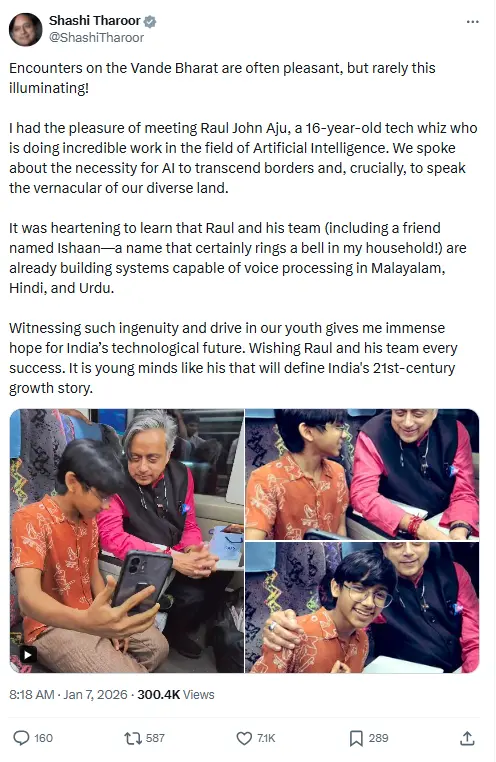
(February 2, 2026) On a Vande Bharat Express journey last month, somewhere between destinations and generations, Congress MP Shashi Tharoor found himself in an unexpectedly absorbing conversation. Sitting besides him was Raul John Aju, a 16-year-old AI innovator from Kochi, Kerala. Their conversation moved swiftly from artificial intelligence to language, access, and the responsibility of building technology for a country as diverse as India.
Tharoor later described the encounter as “illuminating,” praising the teenager’s drive to make artificial intelligence inclusive, accessible, and rooted in India’s linguistic and social realities. The boy already known in tech circles as the “AI Kid of India,” is far more interested in solving problems than collecting labels. At such a tender age, Raul is building AI systems with governments, training over 1.4 lakh people across continents, and speaking on global stages about why India must stop obsessing over marks and start investing in skills, creativity, and research. And he’s doing all this while still attending a government vocational school in Edappally, Kochi.
From a government school to tech stages in India and abroad
Raul John Aju is a 10th-grade student at the Government Vocational Higher Secondary School in Edappally. There is nothing elite or insulated about his educational environment, and that he believes, is precisely the point. He chose to study in a government school, finding its environment more supportive of hands-on learning. The emphasis on extracurricular activity gave him the space to experiment, eventually leading to the development of his own robot. He has also delivered TEDx talks on artificial intelligence, and has spoken at major platforms like India Today Conclave, Dubai AI Summit, Economic Times AI Summit and more.
“I don’t want AI to feel like something that belongs only to big universities or big companies,” he has said repeatedly in interviews and public talks. “If I can build this from a small corner of Kochi, imagine what others can do.”
His journey into artificial intelligence began unusually early. Raul started exploring AI concepts at the age of six, driven not by formal coursework but by curiosity. By 12, he had built his first robot. By his early teens, he created MeBot, an AI-powered humanoid clone that speaks in his voice, answers questions, and explains concepts even when he isn’t physically present.
“I built it because I was kind of lazy,” he joked on stage at the India Today Conclave, drawing laughter from the audience. “After my sessions, students still had questions. So I made a robot that answers them in my way, like a clone of me.” That off hand humour masks a deeper instinct of automation. With MeBot Raul did not intend to replace humans, rather scale access.
Building AI that solves real problems
Today, Raul is the founder and CEO of AI Realm Technologies, a startup focused on building practical, human-centric AI tools. His portfolio includes over ten AI-driven products, many aimed at public service, legal access, automation, and productivity.
Among them is NyayaSathi, an AI-powered legal assistant designed for India, JustEase, a 24/7 legal and emergency-response bot developed for the UAE, ZapGap, which uses AI to reduce cloud and infrastructure costs, MeBot, his humanoid AI twin and social automation tools like FeedFye and StoryScince.
What distinguishes Raul’s work is not just technical novelty alone, but intent. His flagship legal initiative, often referred to as Project 47X is being developed in collaboration with both the Kerala government and the Dubai government. Speaking at the India Today Conclave, Raul explained the motivation behind it. “This is not just for lawyers, but for citizens. If people know their laws, if they know what to do during an emergency, there will be much less corruption.”
He pointed to everyday situations like stolen phones, SIM cloning, contract misunderstandings, where lack of legal awareness leads to exploitation. “Not everyone knows that Indian Penal Code (IPC) has been replaced by Bharatiya Nyaya Sanhita (BNS) sections,” he said. “People don’t know what to do in an emergency. So we are building a bot that explains clauses, drafts basic contracts, and tells you the right steps to take.”
The aim, he stressed, is not to replace lawyers but to reduce the burden on an overstrained system with over 53 million pending cases.
“AI should speak Malayalam, Urdu, Hindi”
His philosophy came into sharp focus during Raul’s viral interaction with Shashi Tharoor aboard the Vande Bharat Express. In a short video clip shared online, Raul asked Tharoor whether AI should be built specifically for India. Tharoor’s response was measured when he responded that while AI should transcend borders, India urgently needs technology that works across its languages.
Raul didn’t miss a beat. “I am going to do most of the language models—Malayalam, Urdu, etc.” Tharoor later reflected on the exchange, writing: “We spoke about the necessity for AI to transcend borders and, crucially, to speak the vernacular of our diverse land.” He went on to call Raul’s ingenuity and drive “a source of immense hope for India’s technological future,” adding that it is young minds like his that will shape India’s growth in the 21st century.
Raul and his team are actively developing voice-processing AI systems in Malayalam, Hindi, and Urdu, focusing on regions and communities that global tech often ignores.
Teaching 1.4 lakh people for free
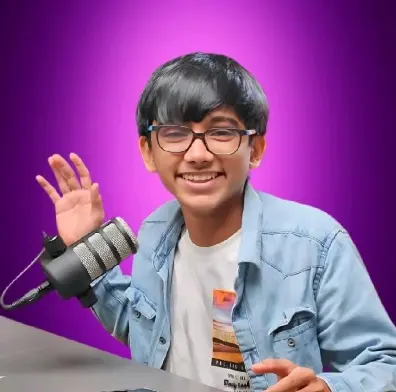
Despite running a startup and collaborating with governments, Raul spends a significant amount of time teaching. Through workshops, live sessions, and online content, he has trained over 140,000 students and professionals across India, the UAE, the US, and the UK.
His sessions have been hosted at IIT Madras, Google Developer events, and international tech forums. On YouTube, he teaches AI “from A to Z”—from basic concepts to advanced fine-tuning and retrieval-augmented generation, entirely free. At the India Today Conclave, he explained why: “I’m literally teaching everything for free. The reason I’m doing all this is so people can solve real-life problems. I’m trying to make India grow.” He is unapologetically critical of India’s obsession with degrees. “Sorry papa, sorry teachers,” he said, half-smiling. “But we need to follow skills and creativity, not just marks.”
The octopus theory of startups
One of Raul’s most memorable moments on stage came when he described startup life using an unlikely metaphor. “Imagine you are an octopus,” he said. “You have eight legs in the form of product development, marketing, sales, customer service, branding, operations.”
For early-stage founders without funding, AI becomes a force multiplier. “AI makes those legs shorter. It helps you do in one day what might take someone else a week.” Citing reports from Forbes and PwC, he argued that AI adoption directly increases productivity, revenue, and competitive advantage, not as hype, but as lived experience. “I am a living proof,” he said. “I built Justice using AI. I do my marketing with AI. Even my presentations.” And yes, he admitted with a grin, he uses AI for homework too.
Leadership that starts at home
One of the more powerful moments in Raul’s journey came when he hired his own father to work at his startup. At 16, it was a decision that surprised many, but for Raul, it was symbolic. “Leadership starts at home,” he has said. Unlike many young founders chasing valuations and viral fame, Raul insists on building with purpose. He believes that innovation should be a daily habit, not a buzzword.
A leader of today, not tomorrow
At the end of Raul’s India Today Conclave session, the anchor summed it up best. “I introduced you as a leader of tomorrow,” she said. “I correct myself. You’re a leader of today.”
While Shashi Tharoor, reflecting upon his meeting with the youngster, joked about a coincidence that his own son is also named Ishaan, like Raul’s collaborator, but added with warmth that his son “wouldn’t have been able to do that at home.” It was humour but also recognition. Because Raul John Aju isn’t just ahead of his age. He’s asking the right questions early, and answering them with code, clarity, and conviction. And at 16, he’s only just getting started.
ALSO READ: Siddarth Nandyala: Texas Teen’s AI app advancing medical diagnostics in the U.S. and India