(December 16, 2025) Indian squash crossed a long-awaited threshold on December 14, 2025. Playing on home soil in Chennai, India clinched its first-ever Squash World Cup title, delivering a commanding 3–0 victory over top seeds Hong Kong in the final through wins from Joshna Chinappa, Abhay Singh and Anahat Singh. Their performance was so decisive that the fourth player Velvan Senthilkumar was not required to take the court. The emphatic win crowned India champions of the mixed-team event and made the country the first Asian nation to lift the prestigious trophy. It also placed India among an elite group as it became only the fourth country after Australia, England and Egypt to win the Squash World Cup.
Beyond the scoreboard, the triumph carried wider meaning. With squash set to make its Olympic debut at Los Angeles 2028, India’s breakthrough has arrived at a moment when preparation meets possibility, injecting confidence and visibility into a sport that has long worked quietly in the background.
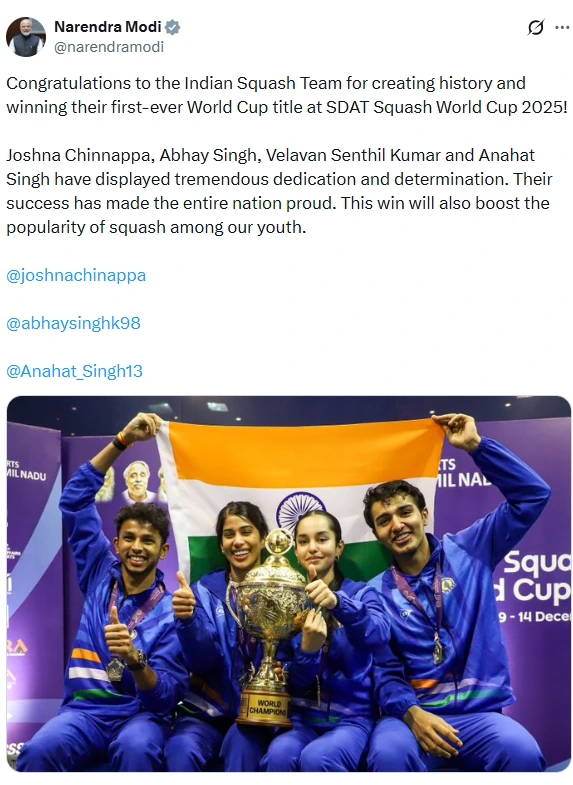
A landmark tournament on home ground
The Squash World Cup 2025, held from December 9 to 14, transformed Chennai into a global squash hub. Matches were staged at the Express Avenue Mall and the Indian Squash Academy, with 12 nations competing in the fifth edition of the mixed-team championship. Defending champions Egypt, runners-up Malaysia, and several established squash nations arrived with pedigree, but it was the host nation that controlled the narrative.
First introduced in 1996, the World Cup has traditionally belonged to a small circle of dominant teams. India’s title run in Chennai signalled a clear shift—less a disruption, more a rebalancing of the sport’s competitive order.
The long road of India’s squash journey
For decades, squash in India existed on the margins, overshadowed by cricket and later badminton. Yet progress never stopped. From early pioneers to modern torchbearers such as Joshna Chinappa, Dipika Pallikal and Saurav Ghosal, Indian squash steadily pushed forward despite limited visibility.
A bronze medal at the 2023 World Cup hinted at what was possible. By 2025, the pieces were in place with stronger grassroots pipelines, world-class academies, and regular exposure to elite international competition. The Chennai triumph was the outcome of sustained, patient work.
Joshna Chinappa: Setting the tone
The final began with experience, and with intent. Joshna Chinappa, ranked 79th, opened India’s campaign against world No. 37 Lee Ka Yi, securing a composed 3–1 win. The victory gave India early momentum and settled any nerves.

Joshna Chinappa
With more than two decades at the top level, Joshna remains the most accomplished female squash player India has produced, including a career-high world top-10 ranking. In Chennai, her role extended beyond the scoreline. Her calm presence anchored a young team navigating the weight of expectation. “It feels surreal to finally hold this trophy,” she said later. “We’ve waited so long, and to do it at home makes it even more special.”
Abhay Singh: Precision under pressure
Momentum carried into the men’s singles through Abhay Singh, India’s top-ranked player at world No. 29. The Chennai-born professional dismantled world No. 42 Alex Lau in straight games in just 19 minutes, pushing India to a decisive 2–0 lead.
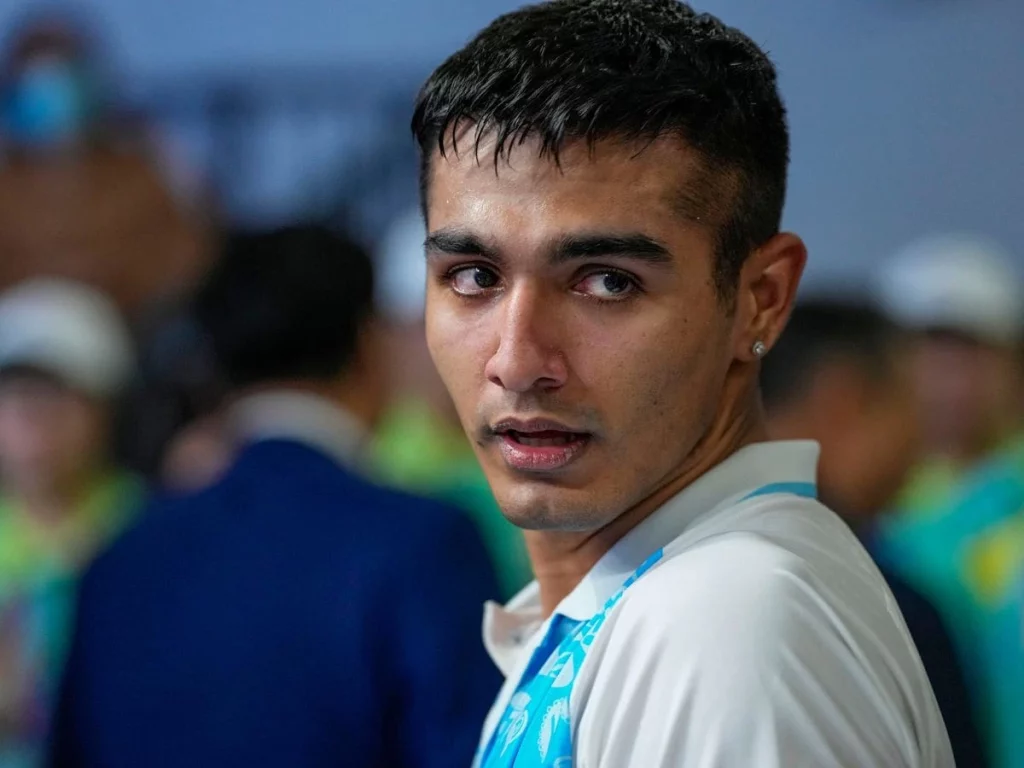
Trained at the Indian Squash Academy, minutes from the venue, Abhay embodies the benefits of India’s improved squash infrastructure. Known for his attacking instincts and sharp reflexes, his performance was efficient rather than emotional, and a reflection of growing maturity within the Indian men’s game. “Winning in front of my home crowd is something I’ll cherish forever,” he said. “This is not just my victory—it’s India’s.”
Anahat Singh: Closing with composure
At just 17, Anahat Singh walked onto court with the title within reach and played without hesitation. Facing world No. 31 Tomato Ho, she delivered a controlled 3–0 win to seal India’s historic clean sweep.

Ananhat Singh
Already on the national radar since the 2022 Commonwealth Games, Anahat showed striking maturity in the final, managing pressure with clarity and restraint. “I just wanted to play my best squash,” she said afterward. “To finish the tie for India is unbelievable.” Her performance ensured that India did not even need to field men’s singles national champion Velavan Senthilkumar in the final rubber.
Velavan Senthilkumar: Strength in reserve
Velavan Senthilkumar did not step onto court in the final, but his presence mattered. As India’s national men’s champion, he represented the depth that allowed the team to close the title decisively in three matches. For Velavan, the Chennai World Cup carried personal significance. Born and raised in the city where he first picked up a squash racquet, competing at home was a full-circle moment.

Velavan Senthilkumar
“I was born here, brought up here and started squash here,” he said ahead of the tournament. “Playing in Chennai in front of a home crowd is special.” That India did not need to call on him in the final was not an omission, rather a measure of squad strength, and of a team confident enough to win before its reserves were required.
A campaign defined by control
India’s title run was built on authority. After sweeping Switzerland and Brazil in the group stage, India defeated South Africa and two-time champions Egypt by identical 3–0 margins in the quarterfinals and semifinals. By the time the final arrived, India looked less like challengers and more like a team setting terms.
When experience meets youthful clarity
India’s 2025 Squash World Cup triumph was built on balance with Joshna Chinappa’s experience, Abhay Singh’s control, and Anahat Singh’s fearlessness. Against a competitive field of 12 nations, India did more than win a title; it demonstrated structure, depth, and intent. As squash prepares for its Olympic chapter, India’s Chennai victory stands as a firm statement. Years of incremental progress culminated not in spectacle, but in assurance as Indian squash did not chase the moment, rather it was ready for it.
ALSO READ: 1970s Beginnings to 2025 Maiden World Cup: India’s win ushers a new era for Women’s Cricket