



(December 20, 2025) When Ashish Kumar Verma joined Microsoft this November as a software engineer at its Hyderabad IDC, the 19-year-old entered the company as one of the youngest to be hired this year. His professional path would have blended naturally into the steady stream of campus placements and lateral hires, except for one detail that instantly sparked curiosity. Earlier this year, Ashish had cracked JEE Advanced and joined IIT Delhi’s Engineering Physics programme but then chose to step away. Yet he still joined Microsoft with an undergraduate credential in hand.
“Microsoft considers both a degree and equivalent experience,” Ashish explains while speaking to Global Indian. Through India’s skill-based certification framework, he had already earned an undergraduate-level credential assessed on demonstrable competencies rather than years of classroom attendance. “I won the National Skills,” he adds, “so through NCVET and Skill India, I got a UG certificate.” Designed to formally recognise industry-ready capabilities, this system allows work done in real-world settings such as Ashish’s experience with startups, including YC-backed companies, to be evaluated and certified as academically equivalent. While still unfamiliar to many, it is becoming increasingly significant in technology hiring.
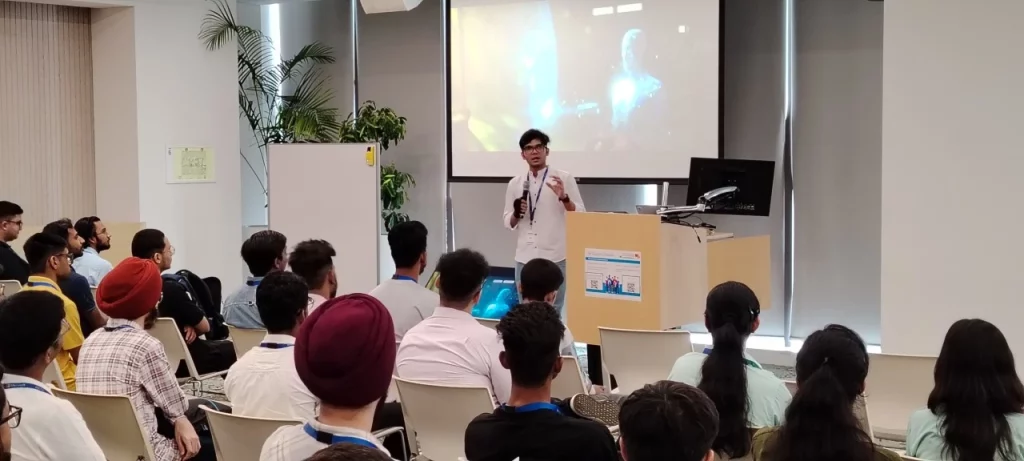
His body of work between 2021 and 2024 formed the foundation of this undergraduate-level certification under India’s Skill India Mission. The assessment was conducted through the National Council for Vocational Education and Training (NCVET), the government body responsible for formally validating vocational and skill-based qualifications. Rather than classroom credits, the evaluation focused on industry-grade outputs like projects, competitive achievements, and professional experience across startups and deep-tech environments which were then certified as academically equivalent to an undergraduate degree.
“I took admission this year,” he says of IIT Delhi, “but the spark was missing for me.” For Microsoft the demonstrated capability of the youngster mattered although he had followed an unconventional route. The multinational company put him through the same process of interviews, technical rounds, and evaluations as any other candidate following a conventional academic path, before finally hiring him.
National recognition, global exposure and solid skill track
This present-day milestone of the youngster becomes clearer when seen against the longer arc of his journey. Long before college choices entered the picture, he had already built a reputation as a consistent achiever. As a school student deeply immersed in science and technology, his projects brought him onto national platforms. He met Prime Minister Narendra Modi twice, once even sharing the stage with him as an anchor during Pariksha Pe Charcha. On another occasion, while showcasing a science project, a discussion with the Prime Minister around student screen habits inspired Ashish to build NamasteScreen, an open-source application designed to reduce mobile phone distractions and improve focus among students.
View this post on Instagram
His innovation extended into classrooms as well. AR Prayogshala, an augmented reality-based learning platform he built to support the implementation of NEP 2020, crossed 25,000 users and was adopted by Kendriya Vidyalaya teachers to create content for the PM eVidya Channel. Global exposure followed when Ashish travelled to Japan under the Sakura Science Program, interacting with researchers, visiting advanced laboratories at Kyoto University and RIKEN, and attending lectures by Nobel laureate Hiroshi Kitagawa. It was an experience that reinforced his interest in blending deep science with technology. “This experience made me realise that I want to combine technology and pure science,” he said, articulating an interdisciplinary ambition that would later shape his academic and career choices. Notably, he chose the Japan programme over a simultaneous opportunity to visit Oxford University, guided by alignment rather than prestige.
Alongside this, he accumulated national awards, coding championship podium finishes, and opportunities to deploy AI systems on high-visibility platforms, shaping a profile defined by steady, hands-on work rather than isolated success.
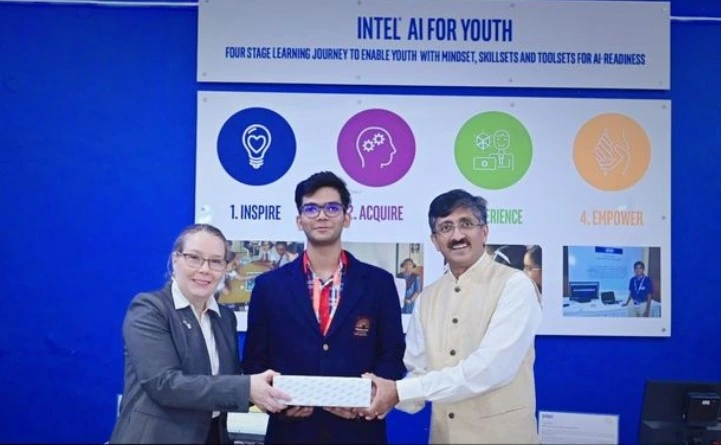
Ashish with Sara Kemp, Vice President, Intel Government Affairs and Gokul V Subramaniam. Intel India President
A childhood mishap that strengthened him
Ashish’s capacity to adapt was forged early. At eight, a serious accident left his right hand severely injured, followed by multiple surgeries and a long recovery. Writing had to be relearned with his left hand, and basic motor skills rebuilt through piano lessons. “The following year was a blur of hospital stays,” he said, recalling how his parents quietly anchored him through that phase. That period sharpened his patience and problem-solving instincts. These traits later found expression in puzzles, coding, and competitive challenges.
IIT Delhi and a reassessment
Clearing JEE Advanced and joining IIT Delhi’s Engineering Physics programme in 2024 was, on paper, a natural next step. Yet within months, Ashish began reassessing. His learning rhythm had already been shaped by building, and replicating real-world systems inspired by work coming out of Microsoft Research and similar labs. He summed it up mentioning, “Most people see getting into IIT as the destination, but for him it was just another puzzle to solve.” Leaving IIT was not about rejecting academia but about choosing a learning environment better aligned with how he worked.
A degree by skills, not semesters
He has spent years doing sustained, verifiable technical work. A Google Developer Expert (GDE) in Web Technologies and a national-level winner in web technology, Ashish has built a profile that extends well beyond classroom learning. As a Microsoft Learn Student Ambassador, he has worked to promote technology literacy, while simultaneously building and shipping full-stack products in real-world environments.
View this post on Instagram
The Microsoft process, unchanged
When Microsoft called, the path forward looked familiar. There were multiple technical interviews, deep problem-solving rounds, and moments of doubt. The evaluation did not bend for his unconventional résumé. The outcome placed him at Microsoft’s Hyderabad IDC, typically associated with deeper engineering roles rather than routine delivery, under the Azure team where he plans to work on AI and infrastructure. As he puts it, this validation did not come from rewriting rules but from proving capability within them.
A story of continuity, not contrast
Ashish Kumar Verma’s journey is not a case against IIT, degrees, or traditional routes. It is a story of continuity of a student who adapted early, built consistently, and chose alignment over symbolism. From national science stages and global labs to IIT Delhi and a government-certified skill pathway, each phase fed into the next. His Microsoft offer, then, is less a surprise and more a culmination, reminding young readers that while paths may differ, rigour, clarity, and effort remain constant.
- Follow Ashish Kumar Verma on LinkedIn
ALSO READ: At Just 17, Geet’s journey spans NASA training to global advocacy in science and sustainability