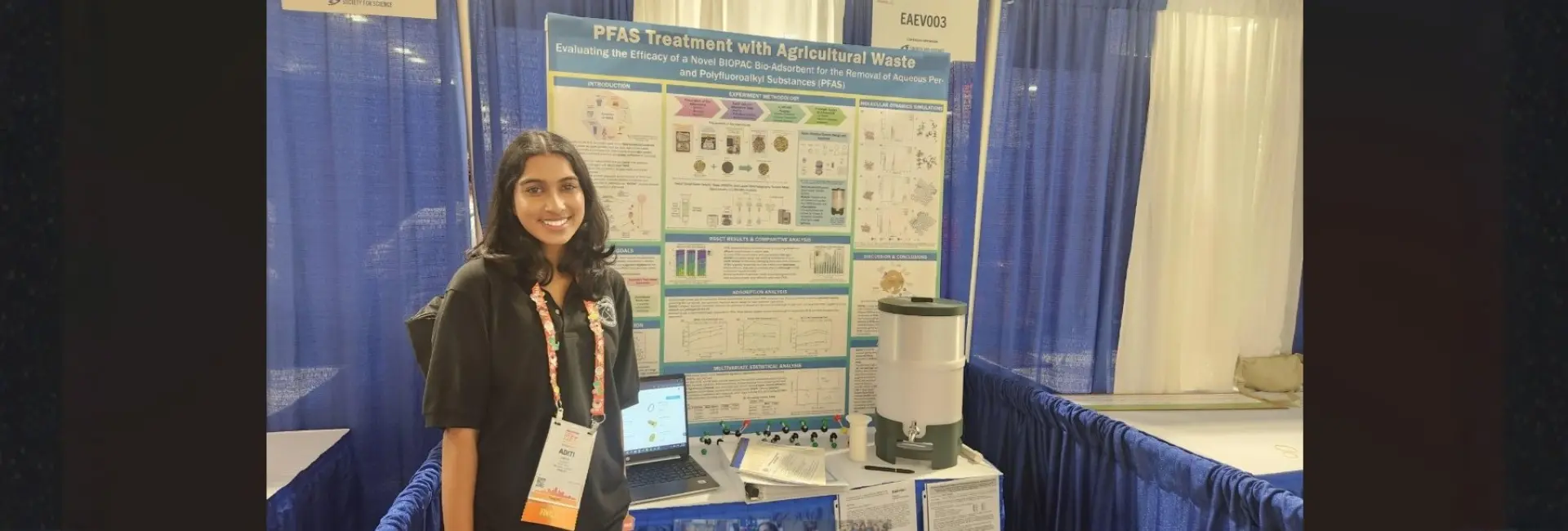


(January 3, 2026) When Orlando-based Aditi Swain stepped onto the global stage at the Regeneron International Science & Engineering Fair in May 2025, it wasn’t just a high-school science project that she was presenting. She was offering a potential solution to one of the world’s most persistent environmental threats, PFAS, the so-called water-borne “forever chemicals” which, she says, are “now found in the bloodstream of nearly 98 percent of Americans.”
In the competition, the 16-year-old student researcher from Orlando Science High School won a 4th Place Grand Award in the Earth and Environmental Sciences category, conferred by the Society for Science, for a novel, low-cost water filtration system that removes PFAS using repurposed agricultural waste. Soon after, she added another international honour: Bronze Award at the International GENIUS Olympiad, one of the world’s largest sustainability competitions for high school students.
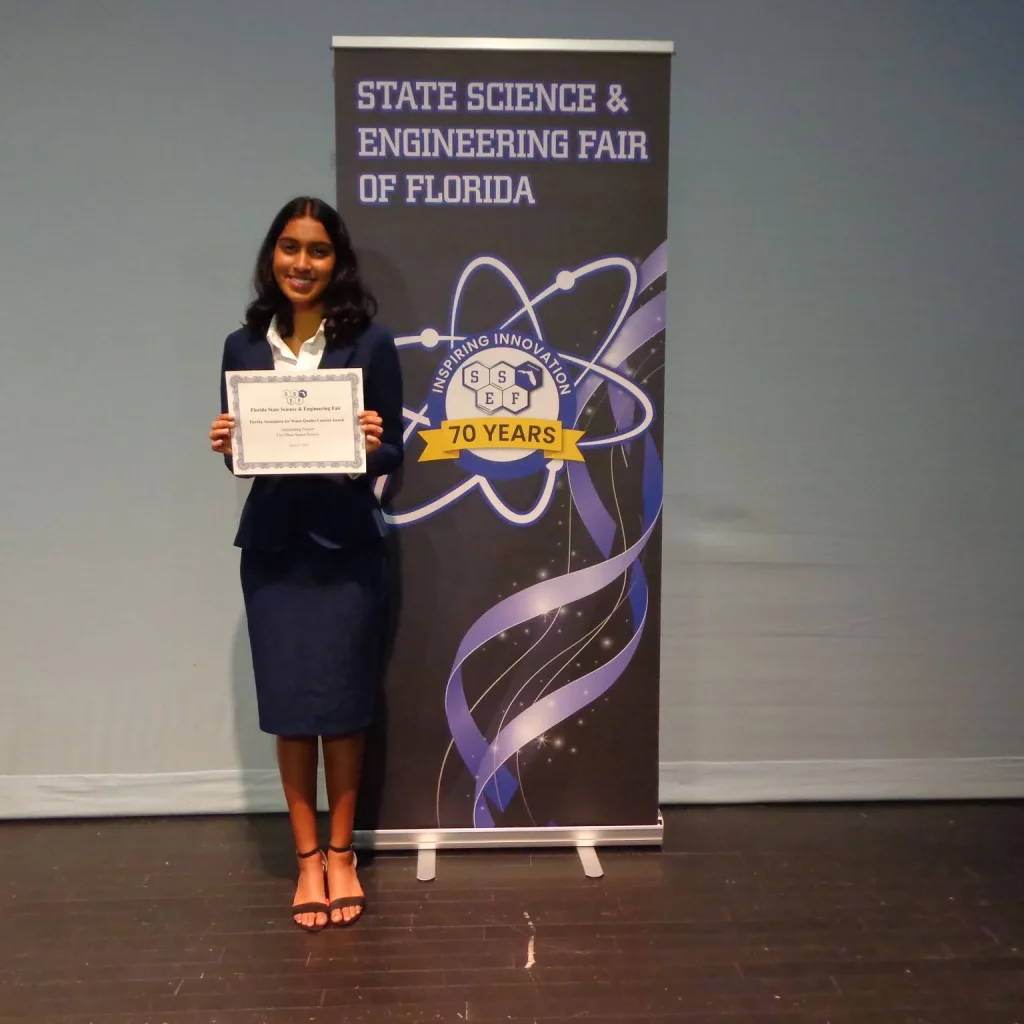
What makes Aditi’s innovation stand out is not just its technical promise, but its intent. Built using materials like sugarcane bagasse and corn stover, her filtration media is designed to be affordable, modular, and scalable, especially for communities where large-scale water treatment is simply not an option.
“This work addresses two urgent crises at once,” Aditi tells Global Indian. “PFAS contamination affecting millions of people, and the massive amount of agricultural and food waste produced every year.”
From Odisha to Orlando
Aditi’s journey into environmental research began long before laboratories and awards entered the picture. She was born in Odisha, India, where both her parents were raised and educated. In 2003, her father moved to the United States through an IT firm, working on a software development project, while Aditi remained in India with her mother and extended family.
“Those years really grounded me,” she recalls. “I grew up surrounded by my relatives, deeply connected to our culture and community.” In 2016, when she was in second grade, the family reunited and moved to Florida. The transition was not easy as there were new schools, a new country, and a language barrier to overcome. “I had to adapt quickly,” she says, “but I also made sure I carried my values with me.”
Today, the Swain household reflects a blend of disciplines and beginnings. Her father works as a software engineer, her mother is a teacher, and her younger brother born in Orlando is now a middle school student. “Living between India and the U.S. really shaped who I am,” Aditi says. “It taught me to take every opportunity seriously.”
A science fair spark that became a mission
Water treatment entered Aditi’s life early, almost by accident. Her first science fair, six years ago, explored how fruit peel waste could remove heavy metals from water. Each year after that, her project evolved, but the theme remained constant. “With every project, my curiosity grew,” she says. “Water treatment was the one thing that always stayed.”
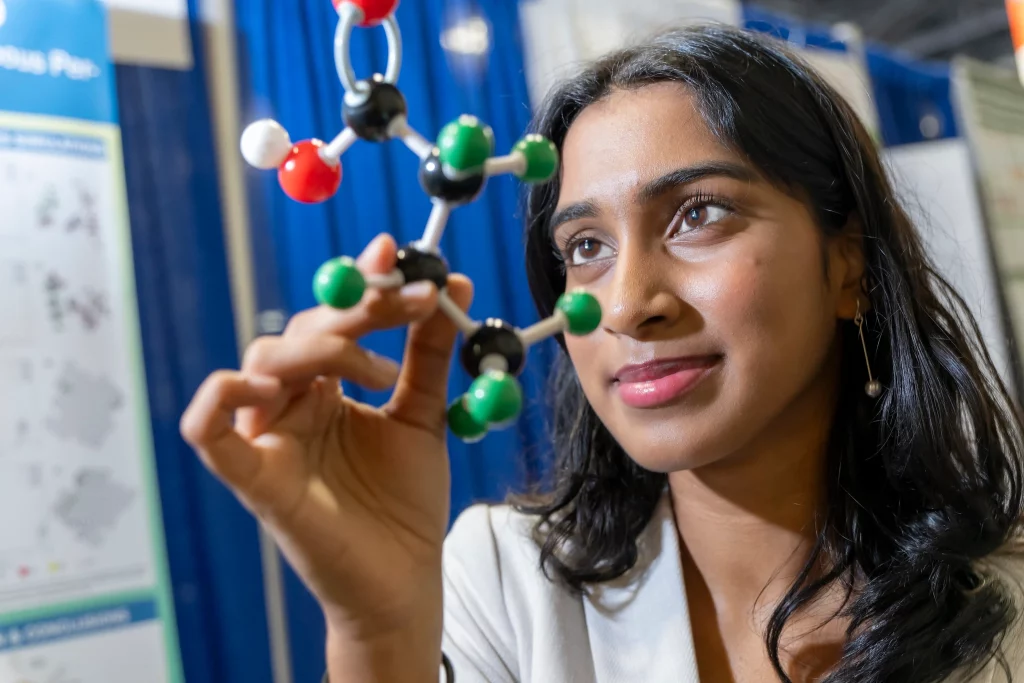
Everything changed when she joined the Water and Wastewater Treatment Lab at the University of Central Florida, working under Dr. AHM Anwar Sadmani and Dr. Md Touhidul Islam. She reached out the way many young researchers do—by cold emailing. “I just asked if I could learn,” she says.
Under their mentorship, Aditi was introduced to PFAS, the synthetic chemicals with extremely strong carbon-fluorine bonds that resist breakdown and accumulate in the environment for decades. Linked to cancer, immune dysfunction, and developmental harm, PFAS contamination is now a global public health concern.
“Conventional treatment systems exist,” she explains, “but they’re often expensive, inefficient, or create secondary toxic waste. That makes them unviable for underdeveloped regions.” Aditi decided to approach the problem differently.
Turning farm waste into a filter
Her solution was a bio-adsorbent filtration media, derived from agricultural waste materials that are widely available and underutilized. Using chemically modified sugarcane bagasse and corn stover, combined with activated biochar, Aditi developed a composite material that captures PFAS through electrostatic and hydrophobic interactions.
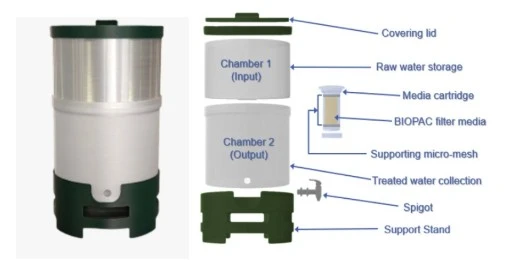
Bio-adsorbent filtration system designed by Aditi that makes use of widely available and underutilized agricultural waste to treat water
“The results showed extremely high performance,” she says. “In some cases, we achieved near-complete removal of certain PFAS compounds.” With lab validation complete, she built a gravity-driven, point-of-use filtration prototype, designed for households rather than centralized plants. The system is modular, easy to assemble, and allows for cartridge replacement at an estimated cost of $3 per filter. “This can be deployed in rural or urban areas where large-scale remediation simply isn’t available,” she explains.
Her mentors played a crucial role in shaping the work. Dr. Sadmani helped refine the project’s design and scope, while Dr. Islam guided her through experimental setup, adsorption testing, and molecular simulations. “They made me think about things I would never have considered on my own,” Aditi says.
Recognition, and responsibility
Aditi Swain’s work has now been recognized across multiple international platforms. In addition to ISEF, she was named Florida’s State Representative for the Stockholm Junior Water Prize, a prestigious competition where one student from each U.S. state advances to a national stage.
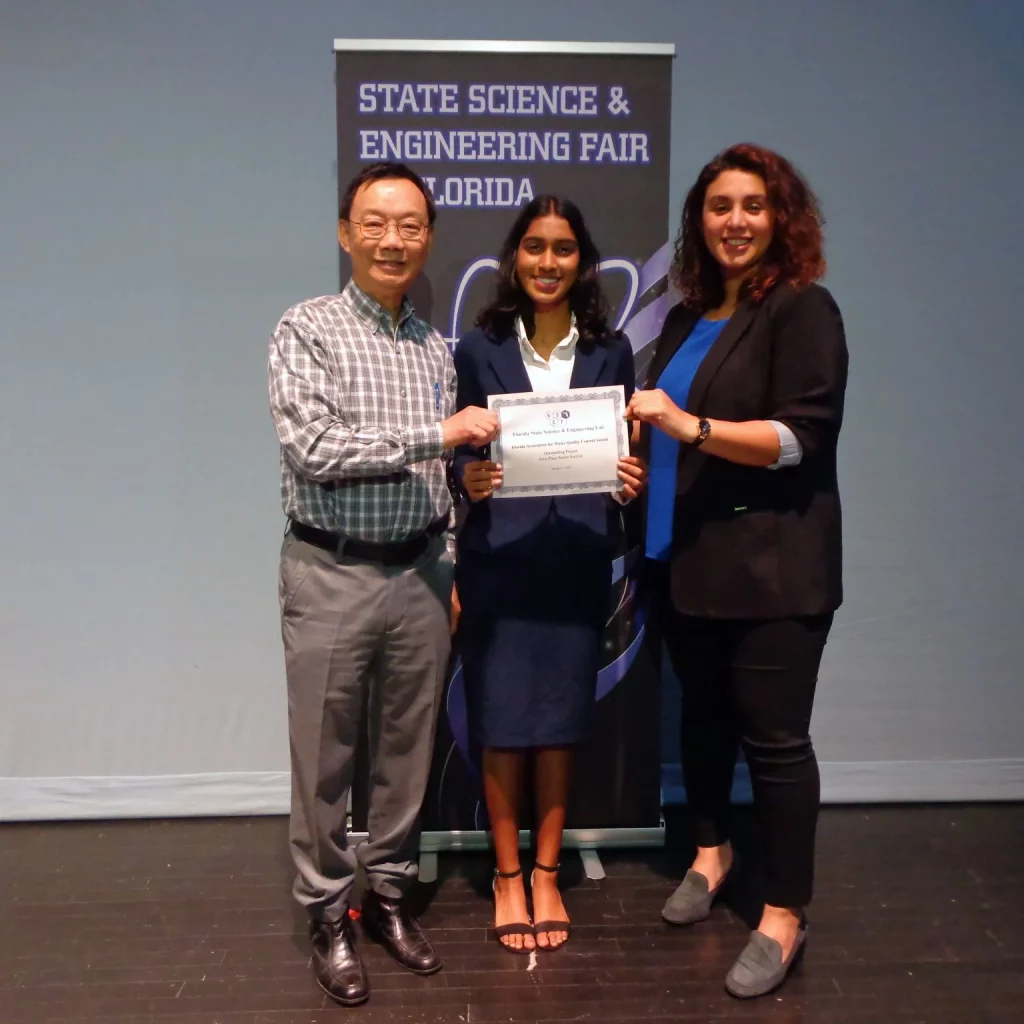
At the GENIUS Olympiad, held at the Rochester Institute of Technology in New York, her project stood out among thousands. In 2025 alone, 2,723 projects were submitted, with just over 30 percent accepted after rigorous preliminary review. Aditi competed in the Science category against 1,698 projects from over 70 countries and 35 U.S. states. But accolades, she says, are only part of the responsibility. “PFAS contamination is becoming more prevalent,” she notes. “Point-of-use solutions are especially important where centralized systems aren’t reliable.”
Giving earth a smile
That sense of responsibility led Aditi beyond the lab. Last summer, while working with the World Youth Parliament of Water, she began reflecting more deeply on environmental injustice, particularly how access to clean water is shaped by privilege.
“Environmental equity isn’t a technical problem,” she says. “It’s a human one.” Together with her best friend Srikrithi Kodimela, she co-founded Give Earth a Smile, an initiative focused on environmental education, youth empowerment, and low-cost solutions.
The organization now spans multiple regions. In Karonga District, Malawi, Aditi and her team are working with the Mtuli Foundation to design school-level lesson plans on water usage and contamination. In Bali, Indonesia, they’re partnering with the Bali Youth Parliament for Water to host capacity-building workshops for young environmental advocates. In the Gaza Strip, the focus is on wastewater awareness and household-level filtration education.
As the initiative grew, they began building low-cost filters and were invited to present at the Florida Association of Water Quality Control annual conference. “Every project looks different,” Aditi says. “But the goal is always the same—to educate, innovate, and empower.”
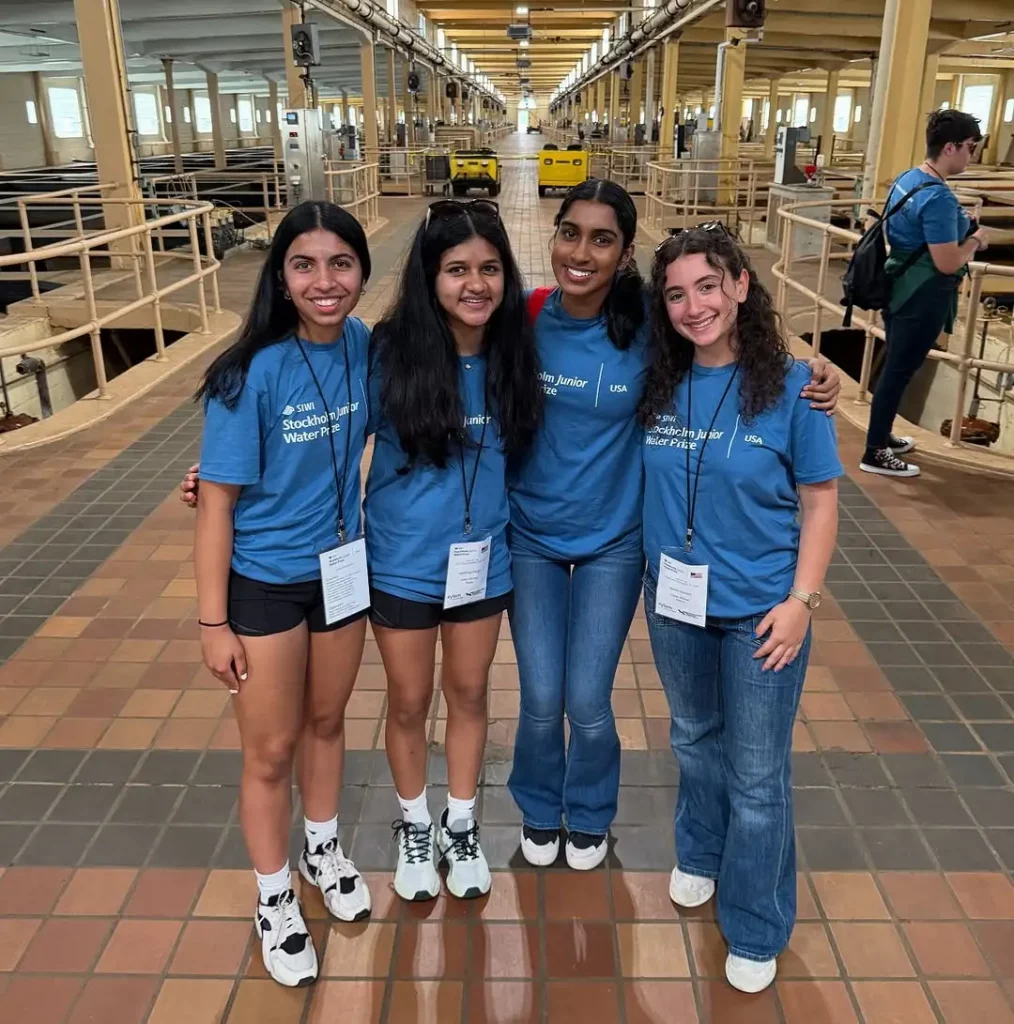
Aditi with friends
Beyond the lab coat
Despite her packed schedule, Aditi remains very much a high school junior. She is a competitive swimmer, training five days a week since middle school, a commitment that she credits with teaching discipline and endurance. She volunteers at the Dr. Phillips YMCA, helping organize swim meets for younger athletes, and at the Orlando Science Center, guiding children through hands-on exhibits.
She has also led a Lego Club at her local library, creating a safe, creative space for younger children to collaborate and build confidence, one brick at a time.
Through SEWA International’s LEAD program, she serves as a youth ambassador, mentoring peers and coordinating humanitarian initiatives for underserved communities in Orlando. “Small actions can lead to real change,” she says. “You don’t have to start big to make an impact.”
Future plans
As she plans for college, Aditi hopes to pursue environmental sciences or biology, with a strong focus on research and innovation. “I want to build solutions that are practical,” she says. “Solutions that actually reach the people who need them.” At just 16, Aditi Swain is already doing exactly that with one filter, one classroom, and one community at a time.
- Follow Aditi Swain on LinkedIn
ALSO READ: Anjali Chadha: The innovator tackling arsenic contamination with science