


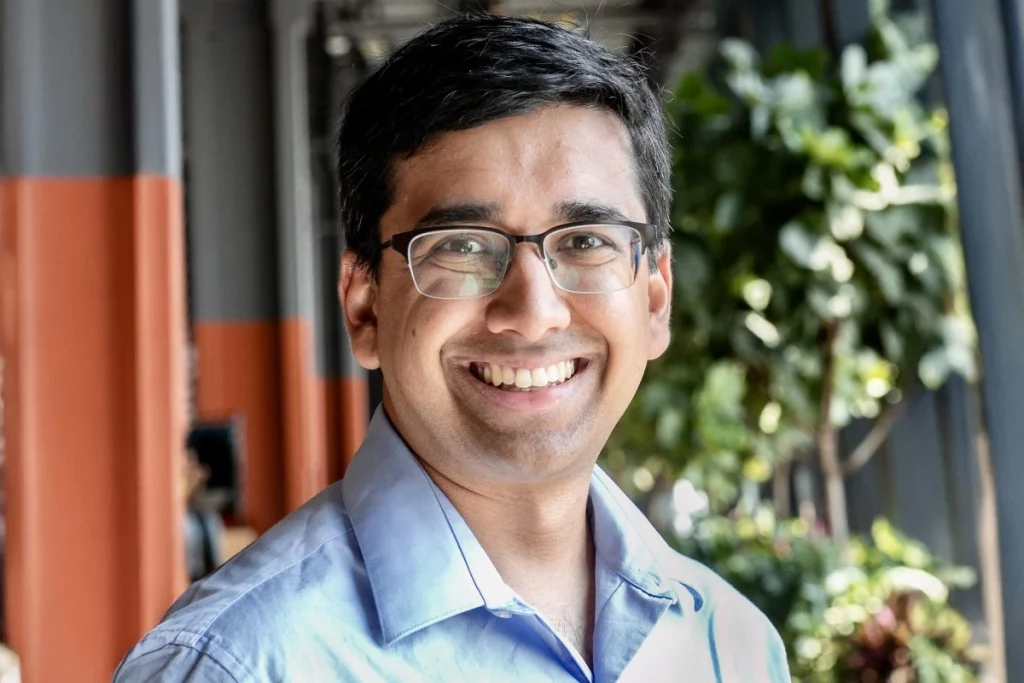
(December 9, 2025) Amid the escalating energy consumption of artificial intelligence and the intensifying challenges of sustainability, researchers are increasingly seeking ways to make AI systems more efficient and more useful for environmental science. Udit Gupta, an assistant professor of electrical and computer engineering at Cornell Tech is one such emerging tech leader. He holds undergraduate degree in electrical and computer engineering from Cornell University, and a PhD in computer science from Harvard University, and worked as a research scientist at Meta before taking up his role in academia. Many of the solutions developed by the Indian-origin assistant professor and his team in the past have already shown real impact in industry settings, reducing the amount of computation needed to run AI systems, and easing the strain on technical infrastructure.
Recently, as part of its first-ever AI and Climate Fast Grants, Cornell Tech, Cornell University’s graduate school and research centre has awarded funding to eight research teams exploring how artificial intelligence can be made more energy-efficient while also strengthening environmental research. Among the inaugural recipients is the Indian-American Udit Gupta, whose project EcoGPT proposes a generative AI interface that significantly shrinks energy consumption by letting users choose slightly slower responses with delays of just a few hundred milliseconds that most people would barely notice.
Steering AI toward a greener future
As reported by Cornell Chronicle, Gupta explained the core design insight mentioning, “Industry benchmarks show that relaxing output generation by small delays – even a couple hundred milliseconds can improve overall system throughout, and energy efficiency by 2.5 times,” highlighting a steep trade-off between lowered response times and system efficiency. With his project EcoGPT, he aims to produce the first dataset capturing how real users weigh response speed against environmental impact. “Our EcoGPT user studies will produce the first quantitative dataset on user preferences for ‘Green AI,’ providing companies with the empirical evidence needed to design practical and sustainable service tiers,” he remarked.
AI’s environmental burden
Cornell Chronicle noted that recent work by Cornell Engineering researchers indicates that by 2030, AI could contribute 24 to 44 million metric tons of CO₂ and consume 731 million to 1.125 billion cubic meters of water each year. To address these pressures, The 2030 Project: A Cornell Climate Initiative, the Cornell AI Initiative and the Cornell Atkinson Center for Sustainability jointly created the Fast Grants program, with funding between $10,000 and $25,000 per research team. Their objective is both scientific and societal in order to develop AI systems that can help mitigate climate change while also minimizing the environmental cost of AI itself.
The EcoGPT experiment
Udit Gupta’s project, EcoGPT challenges one of the core assumptions of digital systems that faster is always better. His research shows that small delays can deliver dramatic improvements in system-wide energy savings. His work reframes output speed not as a static expectation but as a configurable environmental choice. For lay users accustomed to instant responses, the concept that a few hundred milliseconds can translate into significantly lower emissions is unexpected.
EcoGPT turns this insight into a practical interface that lets users “opt in” to greener queries. By studying how people respond to these trade-offs, Gupta hopes to provide AI companies with the first concrete evidence that sustainability can coexist with usability.
Research vision spanning architecture, algorithms and environmental impact
Gupta’s approach to this problem draws from a deeply cross-layered research philosophy. His work sits at the intersection of computer architecture, systems, machine learning and environmental sustainability. He focuses on co-design by building solutions that span applications, algorithms, systems, circuits and devices.
In his own words, “The central theme to my research is co-designing solutions across the computing stack to design and implement computer systems and hardware in new ways to improve the performance, efficiency, and environmental sustainability of emerging applications.” His earlier research led to the characterization of industry-scale neural personalized recommendation models, a contribution that shaped the direction of specialized AI hardware and informed academic systems research. The benchmarking tools he helped develop were standardized by community efforts such as MLPerf, enabling global researchers to evaluate AI performance with consistency and transparency.
A career full of consistent efforts to reduce carbon footprints
EcoGPT is only one part of Gupta’s expanding work on environmental sustainability. In September 2023, he received a $300,000 NSF EAGER award to develop cloud infrastructures for designing sustainable electronics. The goal is to build community-oriented tools that measure the carbon footprint of computing platforms across their lifetimes from assembly line to everyday operation so that future engineers can weigh sustainability alongside traditional metrics. This project also reflects his interest in empowering the consumers. “Electronic Sustainability Records are a key way to raise awareness of the environmental impact of devices,” he explains. “Consumers get visibility on the climate impact their products have, empowering them to make sustainability-focused decisions.”

In 2024, Gupta received two additional NSF grants under the agency’s Design for Environmental Sustainability in Computing program. Supported by a $2 million grant, he examines the environmental footprint of edge computing devices, a rapidly growing category that includes smartwatches, tablets, IoT sensors, smartphones and other connected hardware. These devices are omnipresent, short-lived and produced at staggering global scales, and yet until recently, their environmental impact was largely overlooked compared to data centers. Gupta leads this project alongside Professor Amit Lal at Cornell, Associate Professor Vijay Janapa Reddi at Harvard University and Associate Professor Josiah Hester and Professor Omer Inan at Georgia Tech. Together, they aim to assess and mitigate the escalating resource cost of the world’s most common digital devices.
Making impact through his work
Though the field of sustainable computing is still taking shape, Udit Gupta has emerged as one of the influential researchers in the field. His work has been featured in Bloomberg Green, The Guardian and CNBC, and he has earned IEEE MICRO Top Picks in both 2022 and 2023, with an additional honorable mention in 2021. His dissertation received the SIGARCH Outstanding Ph.D. Dissertation Honorable Mention and the MICRO Outstanding Dissertation Award Honorable Mention in 2023.
Since joining Cornell Tech in July 2023, after serving as a visiting research scientist at Meta, he has helped lead national conversations on sustainable computing. His team has contributed to research on 3D integrated circuits, carbon-aware optimization and sustainable AI systems, while he has participated in major collaborations including a $12 million NSF Expeditions grant for Carbon Connect. His service record includes roles on the HotCarbon program committee, co-organizing the NSF NetZero Carbon workshop, launching the ML and Systems Rising Stars program and supporting early-career researchers across the computing community.
The broader meaning of EcoGPT
EcoGPT may seem like a small tweak with just a few milliseconds of intentional delay but in reality, it represents a shift in how society understands and interacts with AI. It places environmental impact directly into the user experience and turns sustainability into a visible, selectable part of everyday computing. It also signals a future where environmental considerations are not imposed from above but collaboratively explored with users, engineers and policymakers. As Gupta’s projects continue to expand across the computing stack from generative AI to edge devices to lifecycle carbon accounting, they collectively point toward a future where AI innovation is inseparable from sustainability.
EcoGPT is not just about slowing down AI responses; it is about slowing down long enough to reconsider the costs of instant intelligence. In doing so, it offers a blueprint for an AI ecosystem where efficiency, usability and environmental responsibility reinforce one another, rather than compete.

A leader aligning tech ambition with environmental responsibility
The momentum behind Gupta’s work is matched by the recognition it continues to draw across the computing community. In 2024, he received Google’s Academic Research Award (GARA) — a $100,000 grant supporting his project on the Life Cycle Carbon Footprint of AI Inference. His scholarly impact is reflected in repeated IEEE MICRO Top Picks, a distinction awarded by IEEE Micro magazine to the most influential computer architecture papers of the year, as well as dissertation honors from both SIGARCH (the ACM Special Interest Group on Computer Architecture) and the IEEE/ACM International Symposium on Microarchitecture (MICRO). These accolades join a growing list of milestones, including a $12 million NSF Expeditions grant for Carbon Connect, leadership roles in initiatives such as the HotCarbon workshop and the ML Sys Rising Stars program, and foundational NSF grants supporting sustainable electronics and edge-device design.
For a field urgently seeking leaders who can align technological ambition with environmental responsibility, Udit Gupta is a standout figure who embodies what the moment demands.
- Follow Udit Gupta on LinkedIn
ALSO READ: Priya Donti: MIT Professor powering a global movement through Climate Change AI