


(December 16, 2025) Award-winning novelist, screenwriter and former international journalist Reenita Malhotra Hora has spent much of her career telling stories of identity, inheritance and transformation. Now, with The Ace of Blades: The Life Story of the Blade King of India, the California-based writer turns inward to chronicle the extraordinary life of her father, Rajinder Kumar Malhotra, the industrialist who revolutionised India’s shaving industry through iconic brands like Topaz and Supermax, and quietly put a clean shave within reach of generations of Indian men. Part biography, part business history, and deeply personal in tone, the book is both a tribute to a visionary entrepreneur and a reckoning with the cost of greatness.
Rajinder Kumar Malhotra possessed a razor-sharp mind in every sense. Brilliant, stubborn, obsessive, visionary, flawed and deeply human, he was the kind of man who built empires through force of will and engineering precision. His life’s work reshaped Indian grooming at scale, long before liberalisation or global branding entered the national vocabulary. His daughter, Reenita, inherited that intensity—redirected not toward factories and steel, but toward words, narrative architecture and storytelling craft.
“This book honours my father, my family, and the legacy of Indian entrepreneurship,” says Reenita in conversation with Global Indian. “It is the most personal project of my career, and the one that demanded the most courage.”
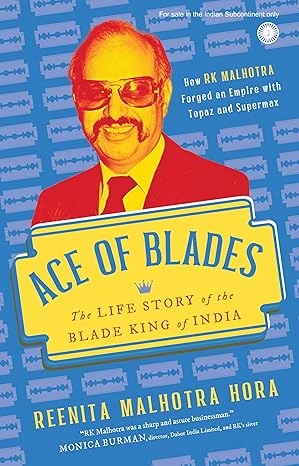
A storyteller shaped by global newsrooms
Before becoming a full-time novelist and screenwriter, Reenita built a formidable career in international journalism. She reported and produced stories across Asia and the United States for institutions that included The New York Times, Bloomberg, Reuters, The Wall Street Journal, South China Morning Post, CNN, RTHK Radio 3, Monocle Radio and the BBC. Her most formative chapter unfolded at Bloomberg, where she worked full-time during the launch of Bloomberg’s Asia broadcast operations. “It was a crash course in discipline and clarity that provided learnings on how to translate complex financial and geopolitical realities into stories actual humans could understand,” she recalls.
Parallel to journalism, her creative writing flourished. Her historical love story Vermilion Harvest: Playtime at the Bagh, set against the 1919 Jallianwala Bagh massacre, won the Overall Grand Prize at the Chanticleer International Book Awards, the Eric Hoffer Book Award, and the Santa Barbara International Screenplay Award. The LA Weekly later hailed her as “a top indie writer redefining Indian culture and comedy for global audiences.”
Why the story of Ace of Blades could no longer wait
The idea for The Ace of Blades lived inside Reenita for decades. “I grew up hearing factory-floor stories over dinner, learning business logic before I understood algebra, and watching a man build a brand through sheer will,” she says. For nearly twenty years, she urged her father to share the unvarnished version of his life—the ambition, the battles, the betrayals and the reinventions. He finally opened up during his last visit to England in October 2020. When he passed soon after, hesitation vanished. “The story stopped being optional. It became urgent.”
What followed was an exhaustive act of documentation. Reenita interviewed former executives, factory workers, international distributors, competitors, industry insiders and family members. She sifted through letters, photographs, private notes, machinery diagrams, advertising material and business records. Writing about someone she loved deeply, and who was far from uncomplicated was emotionally taxing. “It was an excavation,” she says. “But it also became cathartic. Every chapter felt like a dialogue with him.”
View this post on Instagram
Engineering an industry from scratch
At the heart of RK Malhotra’s philosophy was a deceptively simple formula: manufacture the highest-quality blade at the lowest possible price so that every Indian man could afford it, while maintaining standards competitors could neither replicate nor undercut. To achieve this, he didn’t merely produce razor blades, rather built an entire ecosystem around them. He backward-integrated steel production, engineered his own machinery, and maintained uncompromising control over quality. “This was the mechanical engineer at work, the strategist in full command,” says Reenita. “This was the Ace of Blades.”
Launching razor blades was never a romantic dream; it was a calculated engineering obsession. RK wanted India’s first stainless-steel blade at scale, at a time when the market barely existed. When he approached Wilkinson Sword for collaboration, the pricing made no sense for Indian realities. His response was characteristically audacious: if partnership was impossible, he would hire the best talent directly. Ex-Wilkinson engineers joined the effort, and in 1970, Topaz was born.
Topaz immediately distinguished itself through sharpness, durability and consistency. Understanding the power of visibility, RK leveraged film connections through Yash Johar, ensuring Topaz appeared in Bollywood films long before product placement became industry jargon.
Building dominance and daring scrutiny
Distribution proved just as revolutionary as manufacturing. RK built the Malhotra Sales Organization, a disciplined direct-sales army that visited stockists every two weeks with clockwork regularity. Trust, recall and loyalty followed. By the mid-1970s, the Malhotra family commanded between 80 and 90 percent of India’s blade market—a figure so astonishing it is often questioned. “It isn’t a typo,” Reenita says.
That dominance attracted scrutiny. The Monopolies Inquiry Commission investigated the business under MRTP regulations. RK argued his own case, and while the commission eventually stalled and dissolved, the message was unmistakable: his enterprise had become too large to ignore. When the government froze prices on base blades, RK innovated around the blockade rather than yielding to it.
Reinvention through Supermax
When restrictions tightened, RK responded with innovation, launching Bharat Silicon—a coated carbon blade that justified a higher price point and signalled his refusal to be boxed in by regulation.
Around the same time, the Indian market found itself in a peculiar situation: there were now two Topaz brands in circulation—one manufactured by RK’s company, Vidyut Metallics, and another produced by family competitors who still held partial rights to the name. Rather than fight a losing legal battle over ownership, RK chose a sharper, more strategic path. He began printing the word Vidyut prominently on every Topaz wrapper, enlarging the font with each production run until the market stopped associating quality with the name “Topaz” and began linking it unmistakably to Vidyut itself. By the time the Topaz name finally slipped from his hands, consumer trust had already migrated. Dealers who wanted Vidyut Topaz were now compelled to stock his next bet—Supermax—often grudgingly. “They complained and cursed,” Reenita says. “But they took it.”
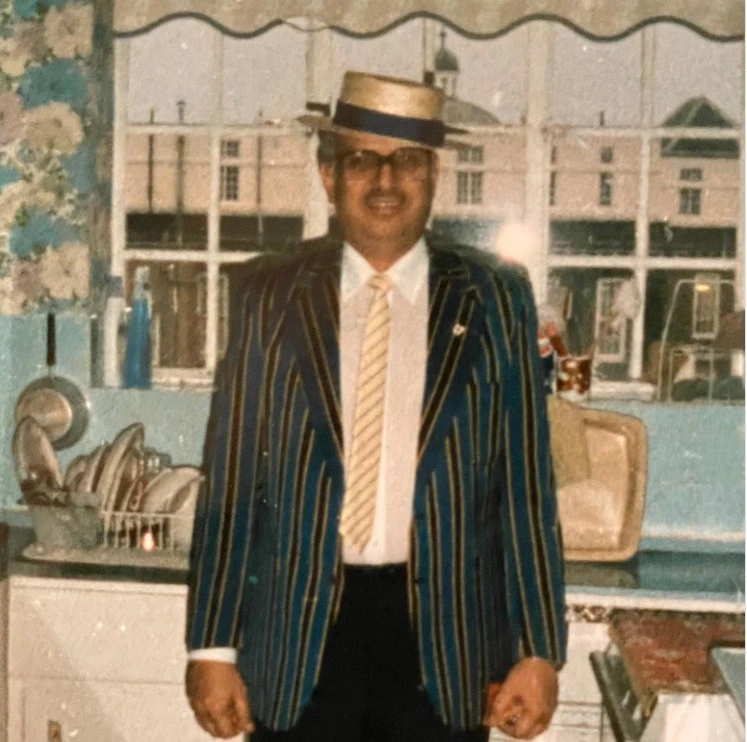
Rajinder Kumar Malhotra
A seizure of Vidyut Topaz containers in Dubai marked another turning point. RK lost the case but gained absolute clarity: never again would any external chokehold threaten his business. Complete vertical integration became non-negotiable. Slowly, Supermax rose independently. By 1998, it dominated southern India with over 90 percent market share, while RK’s other brands captured the north and east.
Reenita’s Journey: From Bombay to Massachusetts
Born in 1970 and raised in Bombay, Reenita absorbed the city’s contradictions early. She attended Cathedral & John Connon School before moving to Williams College in Western Massachusetts, later training in journalism at The University of Hong Kong. Academically, she excelled in what she loved and resisted what she didn’t. Storytelling remained the constant, whether through short stories, theatre or reportage.
While her father built an empire, her mother anchored the family with quiet resilience. “I inherited his ambition and her strength,” says Reenita, who now divides her time between San Francisco and Los Angeles, with Mumbai running beneath it all like an emotional operating system.
Writing women, comedy and the diaspora experience
Her young adult rom-com Operation Mom earned major acclaim as both a novel and screenplay, advancing at Sundance’s Development Track and becoming a semi-finalist at The Writers Lab. More romantic comedies followed, including Pitch Sparks, set in Silicon Valley’s start-up ecosystem, and Christmas in India Square, located in Jersey City’s vibrant diaspora hub. These stories centre South Asian characters with humour, vulnerability and contradiction—mirroring lived immigrant realities.
Projects rooted in culture and imagination
Reenita currently juggles multiple projects unified by identity and transformation. Revolution’s Wife explores the Indian Ghadar movement in early 20th-century San Francisco through the life of Padmavati Chandra. The Arka Chronicles, a middle-grade fantasy series, follows a boy burdened with cosmic power he cannot control. A forthcoming nonfiction book examines how Ayurvedic principles illuminate modern emotional and mental health patterns.
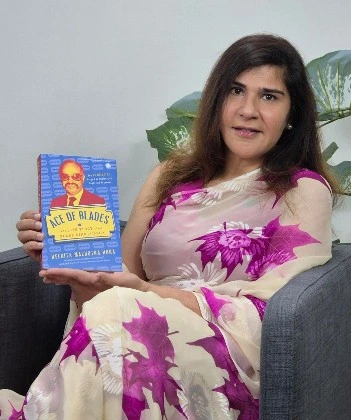
Reenita also hosts two active podcasts—Shadow Realm and The True Fiction Project, and serves as Chief Storyteller at Chapter by Episode, a digital publishing platform for immersive chat fiction.
India as emotional centre
Reenita Malhotra Hora travels frequently to India for research, book promotion and screenplay development. “India remains the emotional motherboard of my life,” she says. “California may be home, but India is the gravitational centre.” To her, Brand India represents acceleration—ambitious, inventive and unapologetically global—an ethos her father believed in long before the world paid attention. His life, now etched into The Ace of Blades, stands as proof that in India, entrepreneurship is instinctive and reinvention a cultural muscle.
ALSO READ: Remembering T. T. Jagannathan of Prestige, the visionary who made Indian cooking safer