


(February 25, 2026) “My parents are Punjabi. They came to America the year before I was born and they came here for one simple reason. They thought their children could be treated fairly and well by the country.”
Neal Katyal shared these words during a recent Hindustan Times podcast while reflecting on his family’s journey from India to the United States. He spoke about his parents’ decision to immigrate and the values they believed the country stood for.
He was speaking after securing a major victory before the United States Supreme Court, where he represented a group of small businesses challenging President Donald Trump’s sweeping tariffs. In a 6–3 decision, the Court ruled that the Constitution vests the power to impose taxes in Congress, not the President, unless clearly delegated. The judgment struck down the unilateral tariffs and reopened debate over the limits of executive authority, placing Katyal, the son of Punjabi immigrants, at the centre of one of the most closely watched constitutional battles of the year.
Katyal acknowledged how unusual the ruling was. “If you go back over the course of our 200 years of American history,” he said, “you’ll see the Supreme Court almost never, maybe never, has really struck down a president’s core signature initiative.”
Describing the verdict, he added: “What happened in this case is that the president said, ‘I can disregard the constitution. I can go beyond it. I can do what I want in the name of foreign policy, in the name of national security, in the name of the economy.’ And what the Supreme Court said, six of the nine justices, is no, you can’t do that. In a constitutional government, you have to color within the lines. You have to comply with the law.”
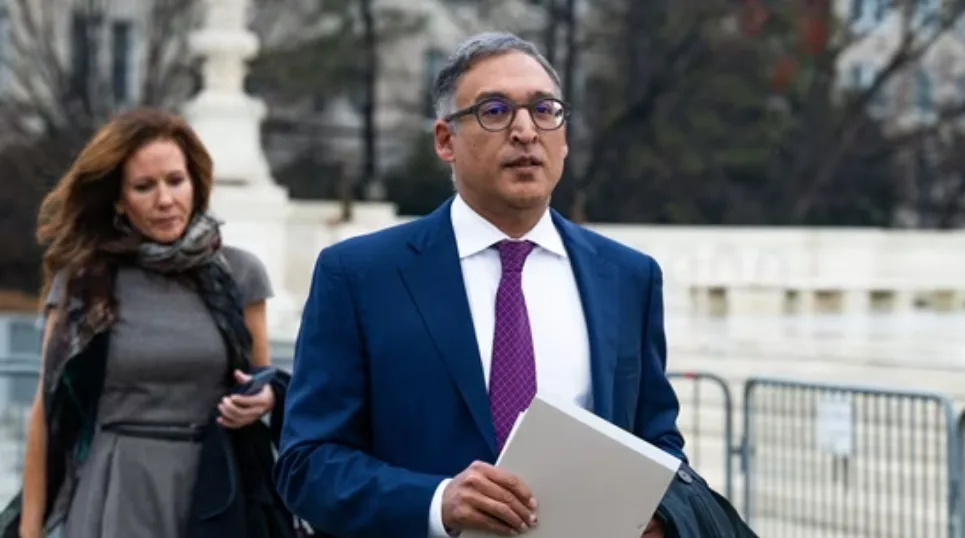
Attorney Neal Katyal with Sara Albrecht, chair of the Liberty Justice Center
A tariff reset: From 50 to 18 to 10 to 15
While the Court’s ruling struck down the sweeping tariffs, the trade story did not end there. India had earlier faced a steep 50 per cent tariff, which was later reduced to 18 per cent after a trade deal. Following the Supreme Court verdict, the rate was brought down to 10 per cent. Soon after, President Trump invoked Section 122 of the Trade Act of 1974 to impose a new global levy, raising the tariff again to 15 per cent.
Section 122 allows the US president to impose temporary tariffs of up to 15 per cent for a maximum of 150 days to address what the law describes as “large and serious” balance-of-payments deficits. These are situations where imports significantly exceed exports. The new duty is slated to take effect for 150 days, with exemptions for certain sectors under separate probes, including pharma, and for goods covered under the US-Mexico-Canada agreement. For exporters and businesses, the rapid shifts from 50 to 18, then 10, and now 15 per cent have created uncertainty.
Katyal himself referred to the ongoing volatility for the past few months mentioning, “I myself was in India earlier this year and bought a bunch of things and wasn’t sure what the tariffs would be as I shipped them to the United States.” For businesses that depend on cross-border trade, he noted, predictability matters. “The rules by President Trump are anything but consistent.”
How Katyal describes the win
Despite the high stakes, Katyal was measured in his reaction. He did not call it a personal triumph. “I don’t think of it as my victory,” he said. “I think about it as a victory for the rule of law, for our constitutional government.”
He explained that Congress has granted presidents certain tariff powers, but those powers are “always temporary or circumscribed in all sorts of ways.” If a president wants broader authority, he said, “the only thing he can do is go to Congress and get authorization.” That, Katyal added, is “the American way.” He also recalled that during his first term, Trump had gone to Congress seeking tariff authority, and “Congress said no.”
Origins: A Punjabi immigrant household
Neal Katyal was born in 1970 in Chicago to immigrant parents from India. His mother, Pratibha, is a pediatrician. His father, Surendar, an engineer, died in 2005. His sister, Sonia, is also an attorney and teaches law at the University of California, Berkeley School of Law.
Katyal said his experience in the United States reinforced his parents’ belief in the country’s legal system. “We are truly a country with the rule of law at its backbone,” he said, adding that he felt “so grateful to it.”
That sense of gratitude shaped how he viewed the tariffs case. He described the policies as “a real threat to what our rule of law and our constitutional democracy is about,” and called it “the most humbling, wonderful privilege” to stand in the Supreme Court and argue “in the name of the Constitution,” “in the name of our businesses,” and “in the name of our citizens.”
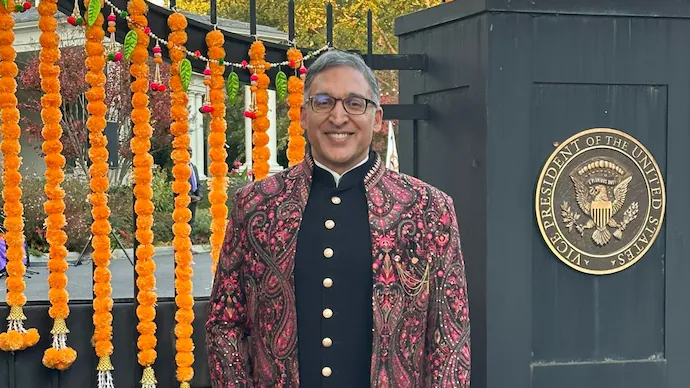
Education and early years
The lawyer studied at Loyola Academy in Illinois before graduating from Dartmouth College in 1991. He then attended Yale Law School, where he served as an editor of the Yale Law Journal and studied under prominent constitutional scholars. After earning his law degree in 1995, he clerked for Judge Guido Calabresi of the US Court of Appeals for the Second Circuit and later for Supreme Court Justice Stephen Breyer.
From government service to private practice
Katyal’s legal career has included some of the most high-profile cases in recent American history. President Bill Clinton commissioned him to write a report on expanding pro bono legal work. In 1999, he drafted special counsel regulations that later guided the Mueller investigation into Russian interference in the 2016 election.
He represented Vice President Al Gore in Bush v. Gore, the case that decided the 2000 US presidential election, and was involved in Grutter v. Bollinger, a case on affirmative action in university admissions.
At the Justice Department, he defended the constitutionality of the Voting Rights Act in Northwest Austin v. Holder, argued in support of the Affordable Care Act, and secured a unanimous Supreme Court decision in Ashcroft v. al-Kidd.
During the Obama administration, Katyal served as Acting Solicitor General of the United States as the government’s top lawyer before the Supreme Court. In 2011, he publicly acknowledged the Justice Department’s errors in the 1942 Hirabayashi and Korematsu cases, calling them “blots” and emphasising the need for candor when the government argues before the Court.
Teaching and honours
After leaving government, he returned to teaching at Georgetown University Law Center and joined private practice. In February 2025, Milbank announced that Katyal would lead the appellate practice at its Washington, D.C. office. He is currently the Paul and Patricia Saunders Professor of National Security Law at Georgetown and a partner at Milbank LLP, an international law firm.
He has received multiple professional honors, including the Justice Department’s Edmund Randolph Award. He is married to physician Joanna Rosen.
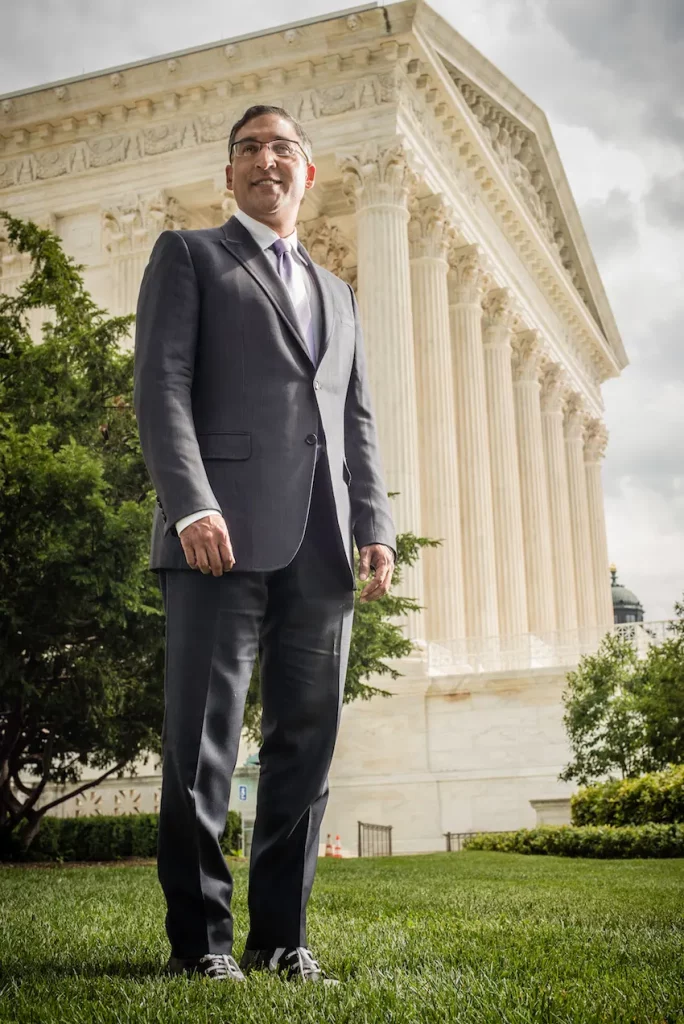
A moment that bridges two democracies
On the podcast, Katyal drew a connection between India and the United States, calling them “the largest democracies under constitutions.”
Talking about standing in the US Supreme Court to argue that presidential authority has limits, Katyal linked his parents’ decision decades ago to a present-day legal battle. For him, the case was not simply about trade policy. It was about whether the rules his parents trusted still hold, and whether even the most powerful office in the country must, as he put it, “color within the lines.”
ALSO READ: Trump’s Legal Voice: Abhishek Kambli and the battle over mass deportation and the Alien Enemies Act