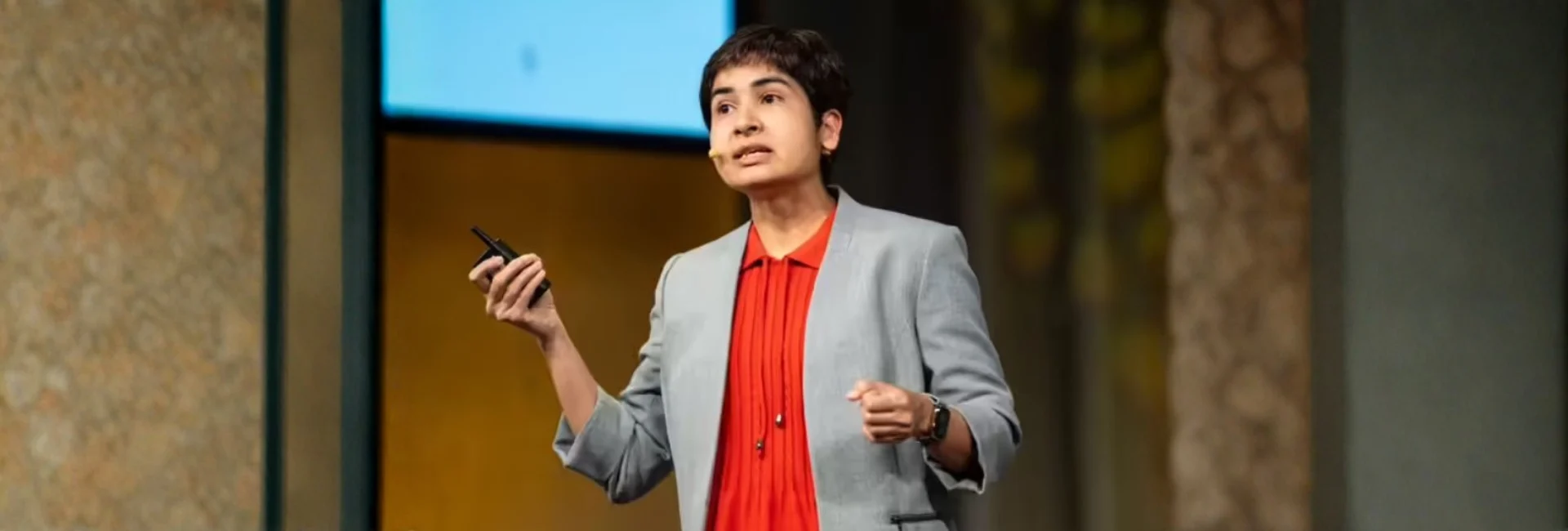


(December 18, 2025) Deblina Sarkar’s journey traces the extraordinary arc of upringing in rural West Bengal to engineering classrooms in IIT (ISM) Dhanbad, and eventually to the frontiers of brain science at the Massachusetts Institute of Technology. Trained as an electrical engineer, she did not begin her career intending to work on the human brain but followed the methodical path into nanotechnology, a field where engineers design ultra-compact devices that must work precisely and consistently, often in sensitive or constrained environments. Today, as an associate professor at MIT and one of the youngest chair professors at the MIT Media Lab, she is known for designing electronics so miniature they can move through the body without disrupting it.
Her latest invention has gained global interest as it points to a safer, more accessible and less invasive way of delivering brain treatment. BBC describes her breakthrough work as something ‘only previously conceived in science-fiction movies.’ Speaking recently to CNN, Deblina drew attention to a staggering reality. “Three billion people around the world suffer from different brain diseases and mental illnesses,” she said, referring to conditions ranging from Alzheimer’s and Parkinson’s to depression, PTSD, blindness, and brain cancers. Many of these patients, she explained, have few effective treatment options.
Her response to that crisis is Circulronics, a tiny, wireless electronic chips designed to be injected into the bloodstream and guided to diseased areas of the brain, potentially offering treatment without risky brain surgery. The ambition behind it is to make brain implants “as simple and accessible as a vaccine.”
Deblina Sarkar is also the founder of Cahira Technologies Inc, an MIT spinoff company that has developed what it describes as the world’s first autonomous, non-surgical electronic implant for treating intractable neural diseases and exploring human augmentation.
Changing how treatment reaches the brain
At its simplest, Circulronics is about changing how treatment reaches the brain. Instead of opening the skull to insert electrodes, Deblina and her team have created microscopic chips that can travel through the bloodstream, cross into the brain, and settle precisely where they are needed. Once there, the chips can be wirelessly powered to gently stimulate neurons—an approach already known to help certain brain disorders. The problem, she points out, is not the idea of stimulation itself, but how it is delivered. Today’s implants, she explained, “require risky brain surgery (that requires) creating a hole in the skull,” and come with risks of infection, morbidity, and high cost, limiting access to a tiny fraction of patients worldwide.
Her solution has been tested extensively in animals and has shown promising results across conditions such as Alzheimer’s disease and aggressive brain cancers. While it remains in the research stage, its potential impact is enormous particularly for patients who currently face an impossible choice between high-risk surgery and living with debilitating symptoms.
Growing up curious
Deblina’s story begins in rural Bengal, where curiosity showed up early and loudly. At just three, she insisted on going to school, even though it meant a long daily journey on foot to the station, a train ride, and more walking before reaching the classroom. That same curiosity shaped her early fascination with electronics, sparked at home as she watched her father improvise by building a washing machine that worked without electricity, and a pulley system that could haul heavy loads up to the roof.
She went on to study electrical engineering at IIT (ISM) Dhanbad, an institution that sharpened her technical instincts and introduced her to research-driven thinking. It was there that she gravitated towards nanotechnology—the science of working with materials at an incredibly tiny scale, measured in billionths, to create new capabilities. While many of her peers were focused on how existing devices worked, Sarkar was already asking what happens when electronics are pushed to their smallest possible limits. “I wanted to create knowledge, add to the production of knowledge rather than just implement what already exists,” she had remarked in an earlier interview with The Telegraph. Her undergraduate research earned international recognition and opened doors abroad, including a summer in Germany working in a leading physics lab.
In 2008, Deblina moved to the United States for higher studies at the University of California, Santa Barbara. There, she began building the foundation of a career defined by the central idea that electronics don’t have to be bulky, power-hungry, or invasive. They can be thin, efficient, and eventually compatible with the human body.
Making electronics gentler on the human body
One of Deblina’s early breakthroughs was an ultra-thin quantum mechanical transistor, a solution also published in the world’s leading multidisciplinary science journal Nature, that challenged long-standing limits in electronics. While the science behind it is complex, the takeaway is simple. She showed that devices could be made smaller and more energy-efficient without losing performance. That work placed her on the global research map and hinted at a future where electronics could safely operate inside living systems rather than around them.
She applied the same thinking to biosensors—electronic tools designed to detect biological changes. By working with atomically thin materials, Deblina helped develop sensors sensitive enough to pick up extremely faint biological signals, paving the way for faster diagnosis and wearable health monitoring. These have been early building blocks of medical technology designed not just for laboratories, but for everyday lives.
When the brain became the focus
Deblina Sarkar’s path took a decisive turn during her postdoctoral work at MIT, where she began focusing on the brain. She worked on tools that allowed scientists to study neural structures at incredibly fine scales, even developing techniques that physically expanded brain tissue so that tiny details could be seen more clearly. It was here that she began confronting a hard truth that many neurological treatments fail not because they don’t work, but because they are too dangerous, too invasive, or too expensive to use widely.
In 2020, she joined MIT’s faculty and set up the Nano-Cybernetic Biotrek Lab, where engineers and biologists work side by side to build devices that can communicate with living systems. Her latest invention, Circulronics emerged naturally from this environment, as the result of years spent thinking about how technology could enter one of the body’s most sensitive organs without causing harm.
Pushing through doubt
The idea of a non-surgical brain implant was not immediately welcomed. Deblina has spoken openly about how dozens of early grant proposals were rejected, with reviewers calling the concept impossible. “For the first two years, more than 35 grants I wrote got rejected in a row,” she recalled, adding that many believed such an implant could not exist. Persistence, however, has been a defining feature of her career. Today, her work is recognised not just for its technical ambition, but for its potential to reshape how neurological care is delivered. She often speaks about families facing devastating diagnoses and having no viable choices left, noting that for many of them, what matters most is hope and time. Circulronics, in that sense, reflects the broader philosophy behind her work that engineering should be driven by human need as much as technical novelty.
Selected awards and recognitions conferred upon Deblina Sarkar
- NIH Director’s New Innovator Award, recognising high-risk, high-impact biomedical research
- IEEE Nanotechnology Early Career Award, where she was the sole awardee worldwide
- Science News’ 10 Scientists to Watch, highlighting her as a global research lead
- MIT Technology Review’s Innovators Under 35, naming her among the most promising innovators from India
- MIND Prize for Innovation in Neuroscience, recognising her contributions at the intersection of technology and brain health
More on Deblina Sarkar: MIT faculty overview and LinkedIn
ALSO READ: A Microscope in Every Pocket: Dr. Manu Prakash’s vision for frugal science