April 15 2026
Amrish Malvankar: Expanding his canvas across continents
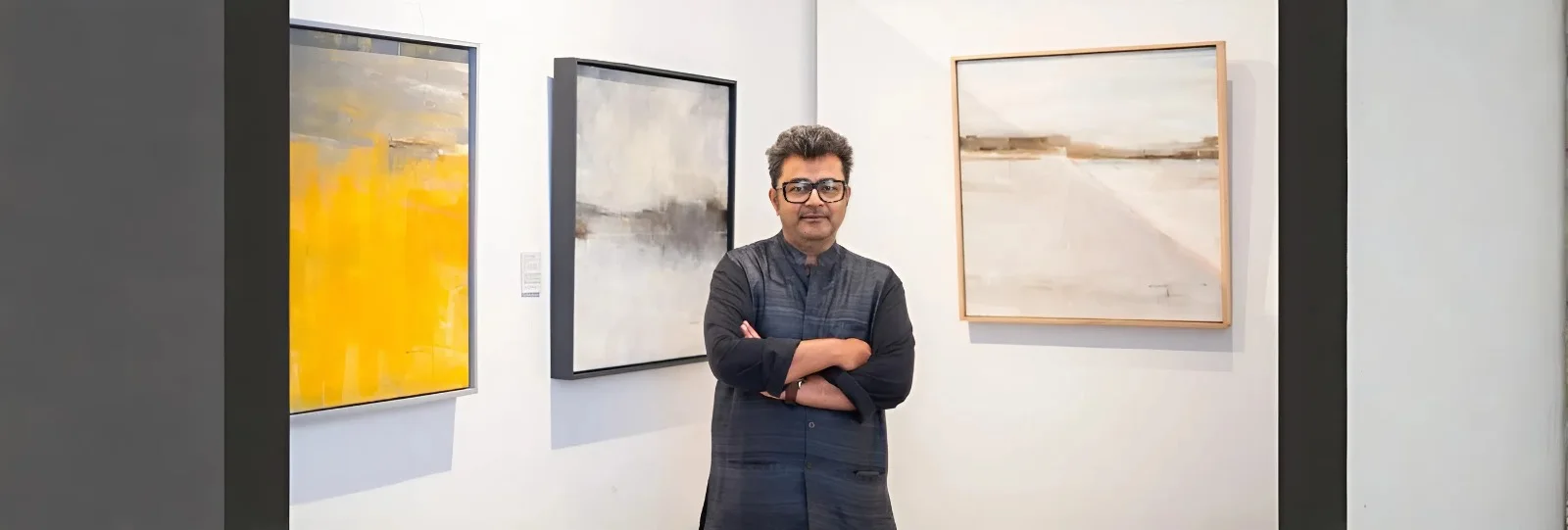
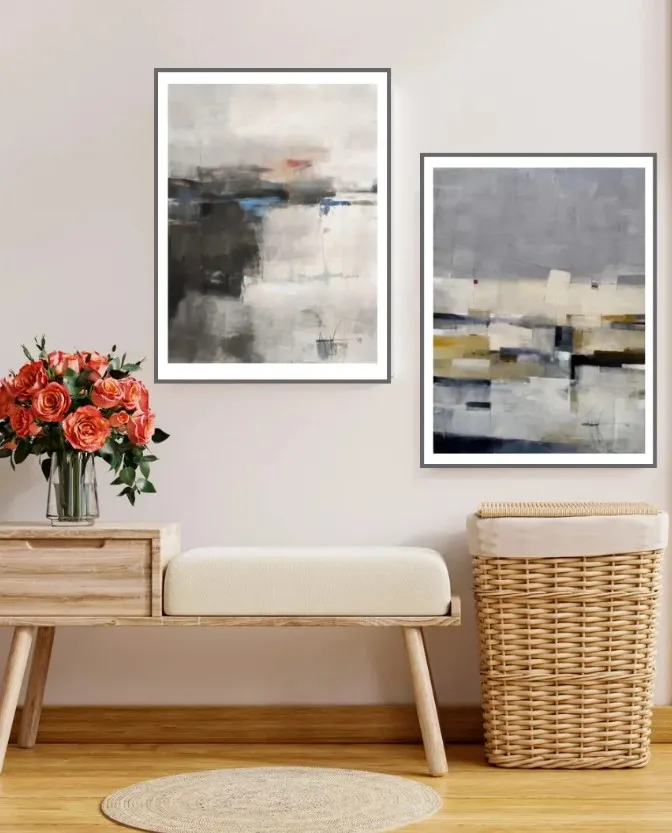
(April 15, 2026) From New York to Dubai, and across art capitals like London, Miami, and Zurich, artist Amrish Malvankar’s work has steadily carved a space for itself on the global stage. His latest showcase abroad was the capsule collection ‘State of Being’ at World Art Dubai, where his work explored the emotional and psychological nuances of the human condition through layered textures and muted tonal palettes. The series invited viewers into a contemplative space, using light, form, and subtle figurative elements to evoke introspection and a quiet sense of inner stillness.
With upcoming showcases at the FOCUS Art Fair, New York and World Art Dubai, the Bengaluru-based artist continues to expand his international footprint. An architect-turned-artist and a graduate of the Sir JJ School of Architecture, Mumbai, Malvankar’s work stands at the juncture of structure and intuition, where spatial discipline meets emotional abstraction. His paintings, often layered with texture and silence, invite viewers into deeply personal yet universally resonant visual experiences.
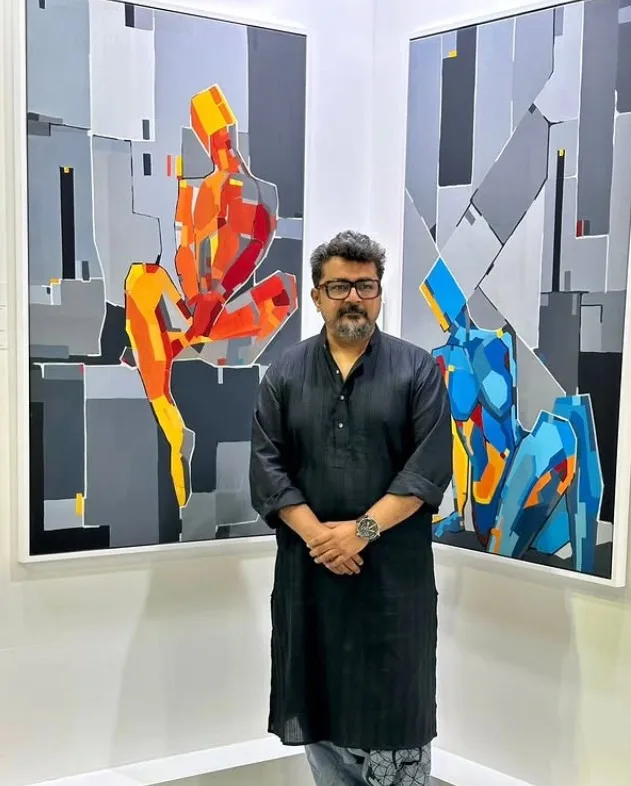
From Mumbai’s visual chaos to a language of form and feeling
The 49-year-old artist was raised in Mumbai and his early years were shaped by a city that is both chaotic and creatively charged. “Mumbai is intense and deeply inspiring,” he reflects. “I was drawn to sketching and visual thinking early on, observing patterns in buildings, streets, light, and movement.”
Though he would go on to formally study architecture, visual expression had always been an intrinsic part of his life. His training at Sir JJ School of Architecture gave him a strong grounding in structure, proportion, and spatial relationships, elements that continue to inform his practice today.
However, the transition from architecture to art was not marked by a single dramatic moment. Instead, it was a slow and organic evolution. “It wasn’t a single defining experience,” he explains. “Drawing and visual expression always felt natural. Over time, it became less about representing something external and more about expressing something internal.”
From structure to self-expression
By 2008, this internal pull had grown strong enough for him to take a decisive step, leaving behind architecture as a profession to pursue art full-time. “That engagement with painting became a necessity rather than a choice,” he says. “That’s when I knew this was the direction I had to follow.”
Despite this shift, his architectural sensibilities remain deeply embedded in his work. Geometry, balance, and spatial layering are subtly woven into his compositions, giving them both structure and fluidity.
Building meaning, layer by layer
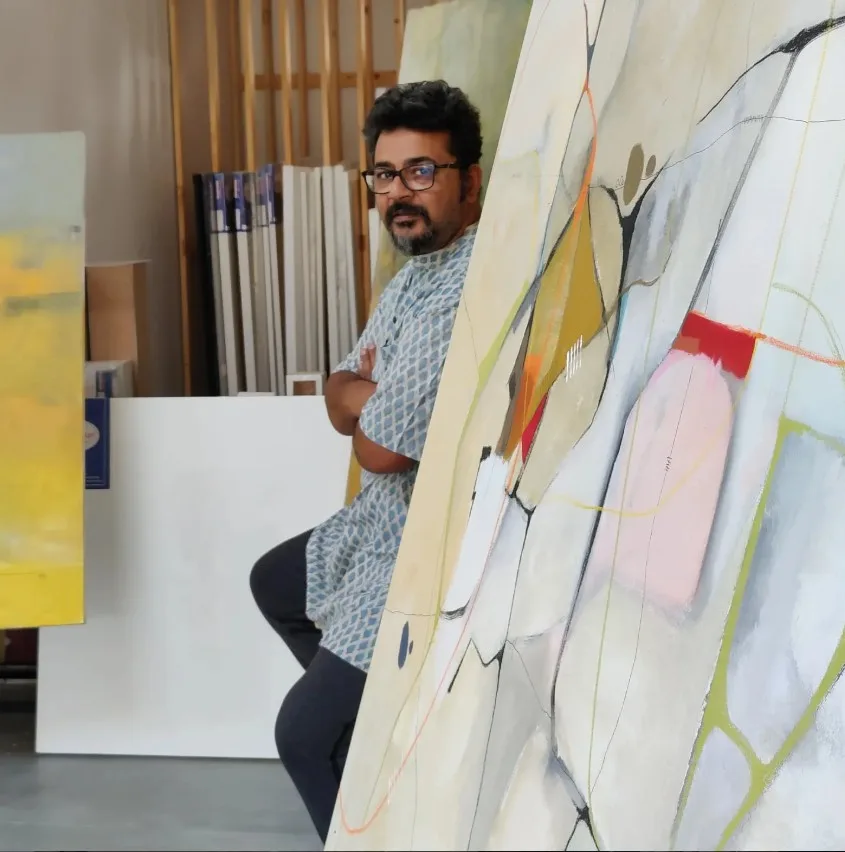
What distinguishes Malvankar’s work is not just its visual appeal, but the philosophy that underpins it. His paintings are not narrative-driven in the traditional sense; instead, they function as open-ended spaces for interpretation.
“In my work, colour and texture are not decorative: they are integral to the emotional and spatial narrative,” he explains. “Layers often conceal as much as they reveal.”
This idea of layering, both physical and conceptual, is central to his process. Each painting evolves through a dialogue between control and surrender. “I usually begin with a tonal direction or a sense of balance rather than a fixed idea,” he says. “The first layers are exploratory, almost like setting a rhythm. Then I respond to what the canvas suggests.”
This intuitive approach allows the work to unfold organically, often leading to unexpected outcomes. Knowing when to stop, he adds, is as crucial as knowing how to begin.
His use of colour ranges from meditative greys and muted tones to more dynamic contrasts, depending on the emotional state he seeks to evoke. Texture, meanwhile, adds a tactile dimension almost like memory embedded within the surface.
India’s rich visual and cultural landscape also plays a quiet but persistent role in his work. “The influences are subconscious,” he notes. “The play of light, the layering of space, a certain rhythm and silence they all come from my surroundings.”
Global conversations
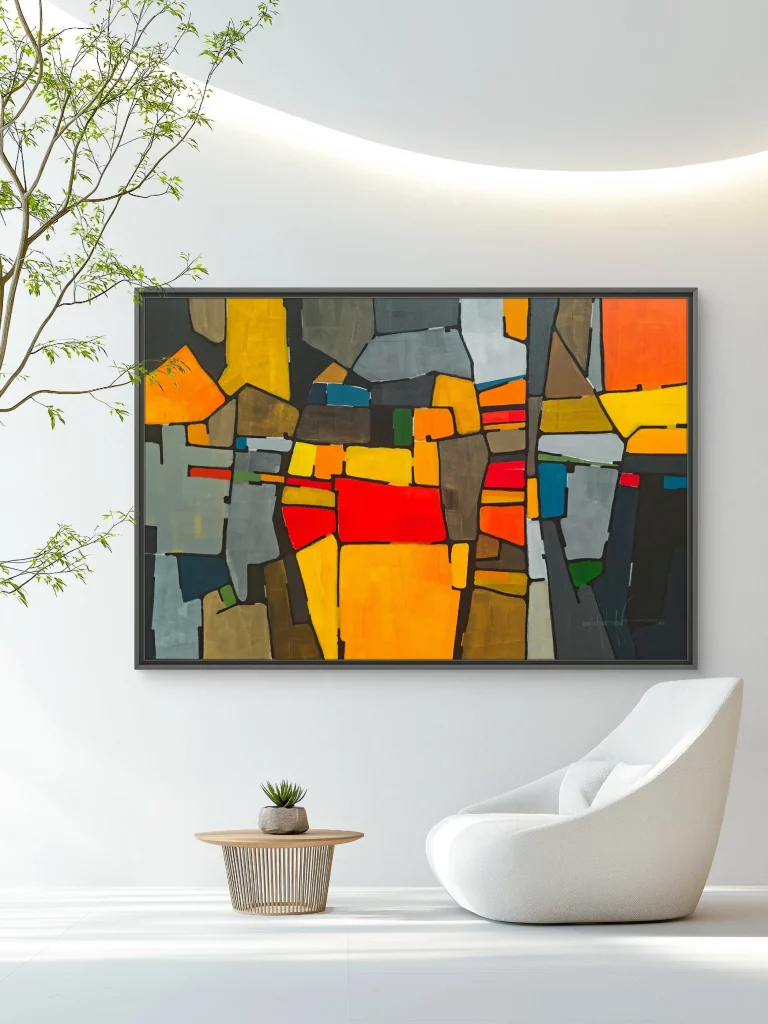
Over the years, Malvankar’s work has found audiences far beyond India, with exhibitions across major international art hubs. His participation in platforms like World Art Dubai and upcoming shows in New York signal not just recognition, but a growing dialogue between his work and a global audience.
“My recent presentations bring together works from different series: Serenity, Syntax, and State of Being,” he shares. “It allows viewers to experience the continuum of my practice.”
Each of these series reflects a different phase of his exploration. While Serenity leans towards calm, meditative compositions, Syntax experiments with a more fluid and evolving visual language. “There’s a shift towards softer edges and less structure in some of my recent works,” he explains. “It’s about allowing the work to breathe.”
Evoking introspection
Experimentation remains central to his practice. From unconventional materials to new textural techniques, he continues to push the boundaries of his medium. Yet, the essence of his work remains unchanged, a commitment to creating spaces that evoke introspection.
One of the most rewarding aspects of his journey, he says, has been the way viewers connect with his work. “There have been moments when people share interpretations I hadn’t consciously considered,” he reflects. “And yet, they feel completely valid. That reinforces my belief that art is about connection.”
Rising over challenges
Like any creative journey, his path has not been without challenges. Periods of uncertainty and self-doubt have been part of the process. But rather than hindering him, these moments have contributed to growth. “Those phases are often where the most meaningful work comes from,” he says.
After more than 50 shows, Malvankar sees his work moving towards greater subtlety and reduction. “I’m interested in how little is needed to evoke a strong emotional response,” he explains. “There’s an ongoing inquiry into silence—how absence can become presence.”
Light, too, continues to fascinate him, not just as a visual element, but as a conceptual one. “It’s not just illumination,” he says. “It’s something that shapes perception and experience.”
Holding contradiction in balance
Amrish Malvankar’s work resists easy categorisation. It is neither purely abstract nor overtly representational, neither rigid nor entirely free-form. Instead, it exists in a space of quiet tension, where opposites coexist and resolve.
Through delicate strokes and bold gestures, through colour and restraint, his paintings invite viewers into a contemplative dialogue. That is what makes his work unique.
- Follow Amrish Malvankar on Instagram
ALSO READ: Across continents and the body: The art of Abhijna Vemuru Kasa
Share with




Written By: Mallik Thatipalli
How Harsha Durugadda built a global sculptural career from a Chilkur farm