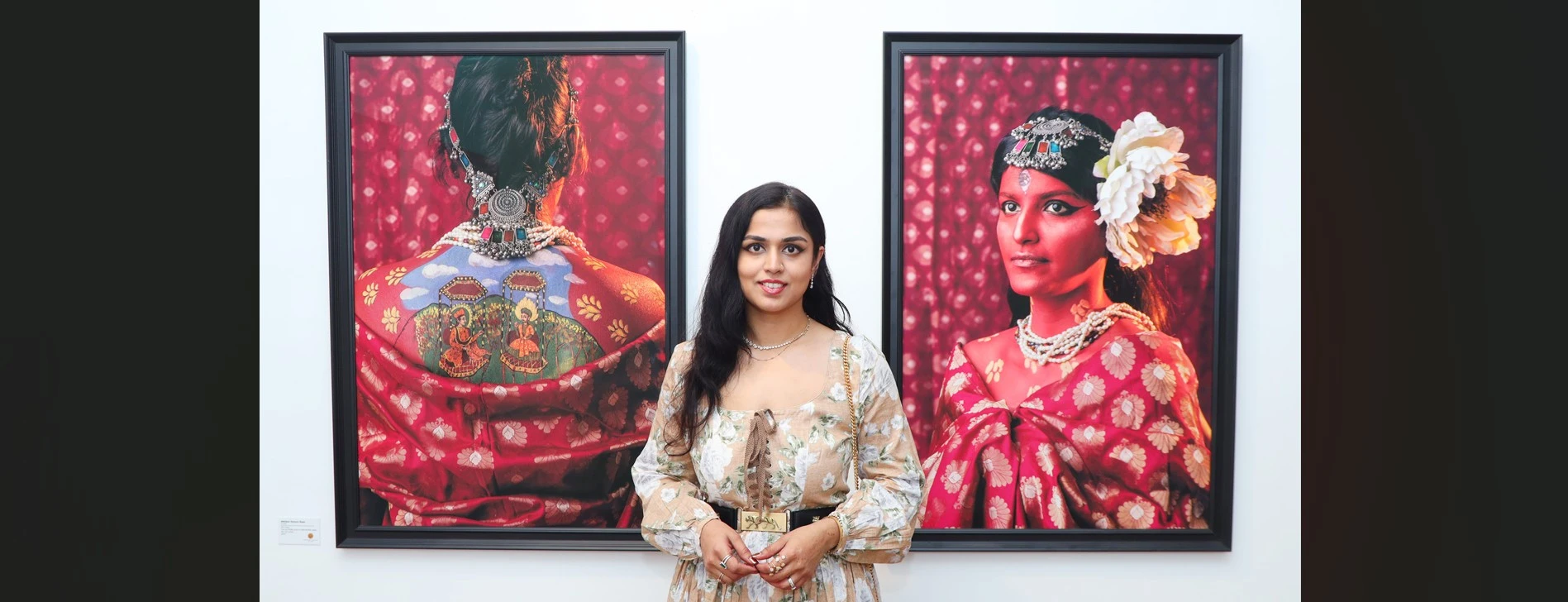


(December 24, 2025) Moving between Hyderabad, Chicago, London, and San Francisco, Abhijna Vemuru Kasa’s artistic journey is as global as it is deeply intimate. Her practice, rooted in lived experience and shaped by transnational education and exposure, interrogates femininity, memory, ritual, and the body through powerful visual and performative languages. Whether through skin, thread or digital space, her work challenges silences around femininity, motherhood, and mental health while carrying the resonance of Indian tradition into global contemporary discourse.
Reclaiming the feminine through art
Each of Abhijna Vemuru Kasa’s artworks tells a gripping story. Revolving around women and femininity, her works are thought-provoking, intense, and often hold a mirror to society. Behind them lie the many emotional and psychological encounters she has experienced as a woman. Drawing equally from mythology, rituals, and personal memory, Abhijna demonstrates a deep affinity to her roots. “I consider femininity to be a misconstrued concept restricted by society to be weak and submissive while actually, it is gender fluid, strong and influential,” she says in conversation with Global Indian.

Her artworks are rich in sensory perception—layered with textures, tactile sensations, and intricate body paint, aiming to externalise aspects of the feminine that have been forgotten or suppressed within public spaces and contemporary politics. “Art for me is a driving force that leads to conversations on any subject matter using the power of culture, perspectives, and collaboration,” she adds.
Motherhood, mental health, and the unspoken
“My works express femininity and the mental health of the feminine, particularly postnatal depression and the unspoken reality of postnatal mental health,” says Abhijna, who works between Hyderabad and San Francisco. She reflects on how motherhood is often idealised and worshipped in society, while the physical and psychological realities experienced by mothers remain largely invisible. “Everyone’s journey during this phase is different, but anxiety, dissatisfaction, and existential crisis are common emotions—often rendered inexplicable due to society’s ignorance,” she explains.
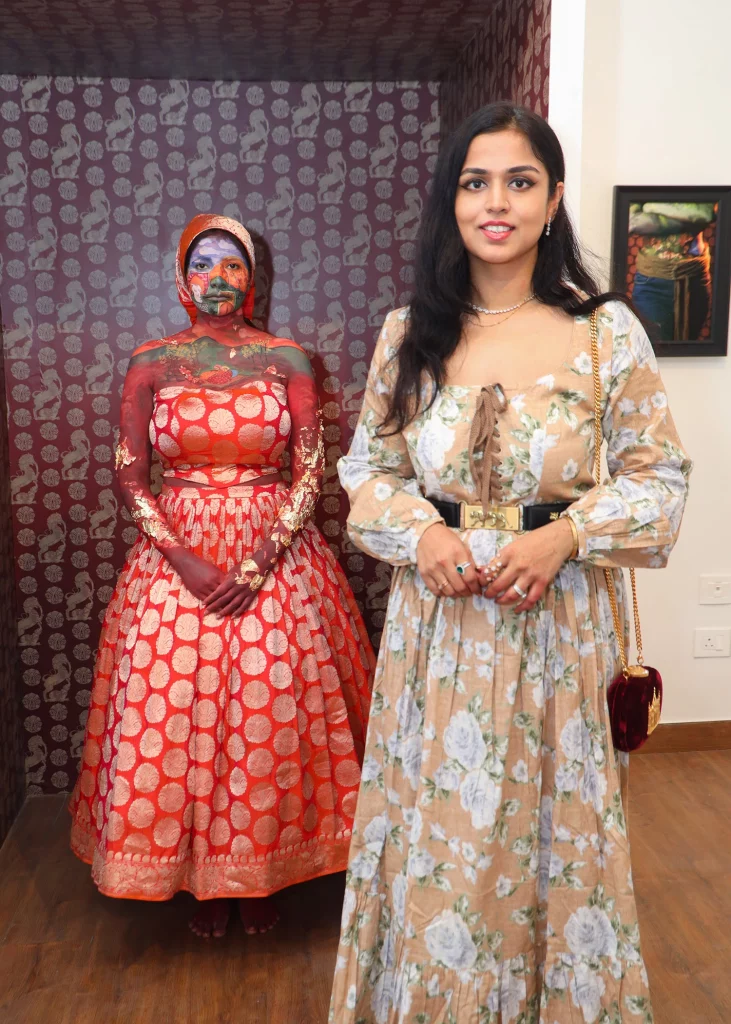
Having experienced postnatal depression personally, Abhijna chose to confront the silence surrounding it through her art. The series uses textiles, illustration, and materials such as belly binds, alongside motifs of progesterone shots and postnatal trauma. Working with oil, textiles, and performance, she consciously selects materials based on the subject matter. “My work plays with various materials picked consciously based on the subject matter,” she says.
Hyderabad Roots
Born in Hyderabad, Abhijna completed her schooling at Bharatiya Vidya Bhavan’s Public School. “I was and still am a very introverted person,” she recalls. Her father, a software innovator, influenced her curiosity across disciplines, while her mother, a creative multitasker skilled in textiles, interiors, and gastronomy became her earliest artistic inspiration. “She has been the greatest influence in helping me understand art and the importance of Indian crafts,” Abhijna says.
Chicago and the making of an artist
At just 17, Abhijna moved to Chicago to pursue her undergraduate studies at the School of the Art Institute of Chicago (SAIC). A merit scholarship recipient, she also won the Martin Luther King Jr. Prize for a mural. “SAIC allowed me to experiment with diverse materials and move across disciplines. That’s where I truly understood the importance of materiality in artistic expression,” she says.
London and artistic maturity
After graduating from SAIC, Abhijna was among the 20 percent selected to study at the Royal College of Art, London. “It was probably the best decision of my life,” she says, crediting her parents for encouraging her to pursue her master’s degree. The RCA experience sharpened her conceptual rigour while expanding her global outlook.

San Francisco and the decision to move back
Following her time in London, Abhijna moved to San Francisco, where she lived for five years. “It’s a place of artists—for art. The street art and creative community encouraged confidence in my work, which revolves around performance registered through photography,” she says. Despite the global exposure, her work remained deeply rooted in Indian rituals and traditions. “I love the conversation my work creates in different geographies and the contrast in how viewers in India and California respond,” she notes. Eventually, she and her husband decided to move back to India so that their two children could grow up closer to their roots.
Looking Ahead: Global practice, new media
Abhijna now envisions a fluid future, working in Hyderabad while taking her art across borders. She is exploring new media, including digital platforms such as Unreal Engine and virtual reality. “Art is often conveyed by providing an experience, and digital media can deepen that experience for the viewer,” she says. A poet as well, Abhijna sees no separation between her practices. “Writing poetry is equivalent to painting a picture for me.”
Inside her latest exhibition
Her global sensibility finds a compelling anchor in her ongoing solo exhibition, Ski(e)n – Re-membering the Self through Skin and Thread, currently on view at Delhi’s iconic Dhoomimal Gallery until January 10, 2026. Curated by Jyoti A. Kathpalia, the exhibition brings together performance, textiles, immersive installations, and painted bodies to explore how skin becomes a site of remembrance, resistance, and reclamation.
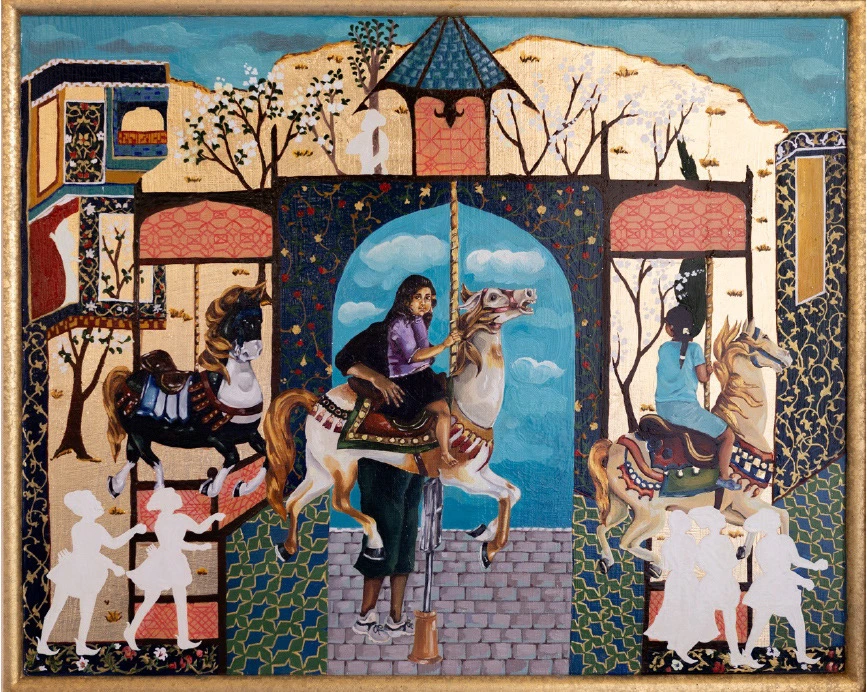
Among the works on display at Ski(e)n, standouts include The Postnatal Torso, Carousal of Life, The Progesterone Shot, and Odalisque. Other powerful pieces such as Kali, Smriti, Meenakshi, Aarya, Sisters of Andal, The Homeless Girl Child, and The Debutante leave a lasting impression. Collectively, the exhibition weaves an intricate tapestry of memory and experience, drawing from decorative art motifs, flora and fauna, local deities, miniature traditions, and the Cheriyal Scroll Painting. Through performance and body painting, Abhijna treats the skin as a ritualistic and performative surface, reclaiming feminine agency while exploring transformation through the body itself.
View this post on Instagram
At the intersection of body, memory, and geography, Abhijna Vemuru Kasa’s art stands as both personal testimony and collective reckoning with Ski(e)n marking a significant moment in her evolving practice.
- Follow Abhijna Vemuru Kasa on Instagram
ALSO READ: Suman Kabiraj: Painting the world through an Indian lens