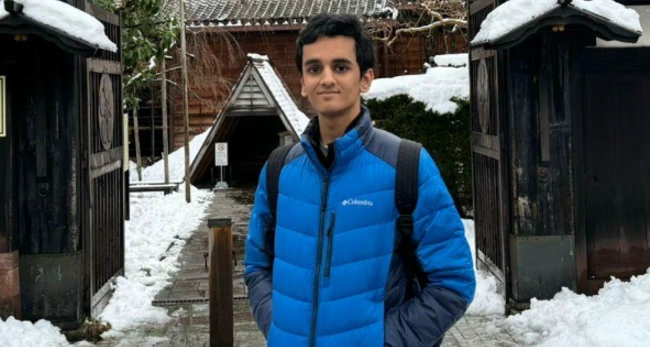


Name: Hamza Mohammad Syed | University: London School of Economics and Political Science | Course: MRes/PhD in Economics | Location: United Kingdom
Key Highlights
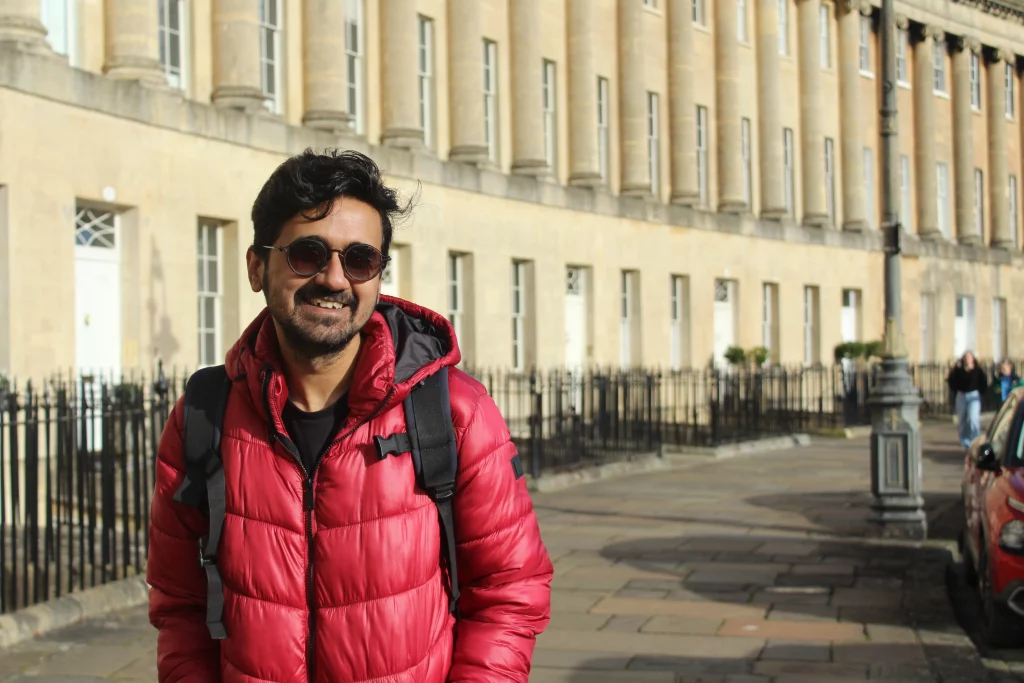
From a small village in eastern Uttar Pradesh to the hallowed halls of The London School of Economics and Political Science, Hamza Mohammad Syed’s journey is shaped by education, persistence, and the determination to understand and address inequality. Hamza is pursuing an MRes/PhD in Economics at LSE, working at the intersection of political economy, development, and energy and environment.
His research examines discrimination in housing, unequal access to resources, and the uneven burdens of climate change, questions deeply rooted in lived realities across India and the Global South. Hamza’s work remains anchored in concerns that matter back home — access, opportunity, and dignity. The researcher aspires to take this knowledge back into Indian academia.
The power of education
Hamza grew up in Pokharbhitwa, a village in Siddharthnagar district of Uttar Pradesh, where educational opportunities were limited but belief in education was absolute. “The biggest influence for me were the stories people told about my grandfather, Anwar Ahmad,” he recalls. Despite scarce resources, his grandfather ensured that all his children were educated: an extraordinary commitment for the time and place.
That legacy was carried forward by Hamza’s parents, who run a primary school in the village focused on providing quality education and strong foundations for local children. Hamza and his siblings studied there until Class 5. “Even though opportunities for higher education were limited, the importance of education was instilled in us from a very early age,” he says.
This belief took him away from home early, first to Lucknow for school, then to Delhi for an undergraduate degree in Economics at Hansraj College, and later to Pune for a master’s at the Gokhale Institute of Politics and Economics. The transition was not easy, but strong teachers at every stage kept him motivated. Looking back, Hamza reflects on how “one man’s prioritisation of education over everything else has already shaped generations.”
From corporate risk to development research
Hamza’s first professional role was at HSBC, where he joined as a Risk Analyst in the model monitoring team for the Asia-Pacific region. The role introduced him to large-scale data analysis, institutional systems, and the mechanics of credit decision-making. “The most useful things I learnt there were data analysis techniques, presentation skills, and how important it is to have a supportive team,” he says.
Yet academia remained his long-term goal. While working at HSBC, he began applying for PhD programmes abroad and quickly realised that research experience was essential. This led him to J-PAL, where he joined as a Senior Research Associate on energy and environment projects.
At J-PAL, he worked across all stages of field experiments, from designing Randomised Controlled Trials and survey instruments to analysing data and writing grants. He travelled extensively for fieldwork and collaborated with government officials, NGOs, and researchers
across institutions. “The exposure I got there was something I couldn’t even have dreamed of,” he says. The experience proved pivotal in securing PhD offers, including one from LSE.
Research, teaching, and life at the LSE
Choosing LSE was both an academic and strategic decision. Throughout his academic life, Hamza had seen how good teachers and rigorous research could shape students and institutions. “To make a meaningful change, it felt like credibility mattered,” he says, explaining why he prioritised globally recognised universities.
At LSE, he found mentorship from leading scholars and an intellectually demanding environment. Over five years, he grew both as a researcher and as an individual. Teaching undergraduate and master’s students, he says, has been the most rewarding part of his time there.
His current research focuses on discrimination in housing markets, unequal access to energy infrastructure, and disproportionate exposure to pollution and climate risks. Some of this work draws from personal experience. “Discrimination in housing is something I’ve faced myself while trying to find a house in different parts of India,” he notes.
Using survey experiments, administrative data, and theoretical models, Hamza examines how identity-based segregation affects economic outcomes for minorities. On energy access, he studies how infrastructure and political contexts shape education, healthcare, and labour participation outcomes. Alongside research, he teaches quantitative methods, macroeconomics, and statistical inference, reflecting his belief in strong methodological training.
Living between worlds
Adapting to life in the UK came with challenges: academic rigour, administrative systems, and the high cost of living. “The courses are designed to make you think, not memorise,” Hamza says, noting the sharp shift from Indian exam systems. London’s diversity, however, made integration easier. “There are so many different people that nobody is really different,” he observes, adding that ideas matter more than accents.
Outside academia, football, long walks, theatre shows, and food markets help him stay grounded. He has built a strong support system of friends from around the world and speaks positively of London’s inclusiveness, saying he has not experienced racism in the city. He adds, “London has a lot of history, I like to take walks in different parts of the city. I also try to play football as often as I can. There are a lot of theatre, comedy, and music shows and you can sometimes find cheap tickets. There’s also a lot of weekend food markets that serve food from all over the world.”

Looking ahead
Looking to the future, Hamza plans to continue in academia after completing his PhD, with a strong desire to remain engaged with Indian institutions. Teaching and research, he believes, are where he can contribute most meaningfully.
From Pokharbhitwa to London, Hamza Mohammad Syed’s journey reflects the role globally trained scholars can play in shaping more equitable futures back home.
Hamza Mohammad Syed’s advice to students applying abroad:
- Speak to current students or alumni to get a realistic sense of the course structure, academic expectations, and life at the university.
- Be clear about your finances, as applications and study can be costly.
- Choose courses that genuinely interest you and be prepared to put in the effort to learn.
Follow Hamza Mohammad Syed on LinkedIn