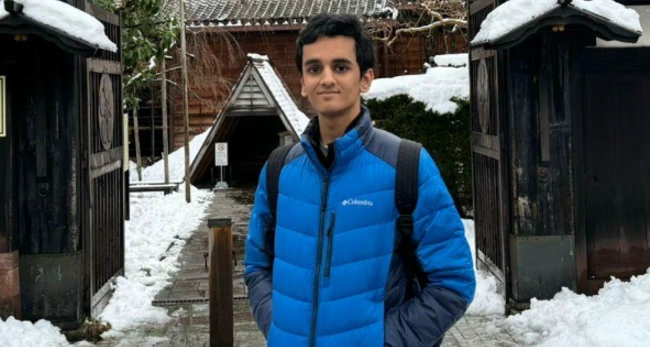


Name: Manjari Kothari | Institution: The University of Edinburgh | Course: MSc, Psychology of Mental Health | Location: UK
Key Highlights
• Calm and harmony: Edinburgh offers Manjari the rare balance of vibrant city life and reflective calm
• Academic intensity, human support: A demanding curriculum is made rewarding by patient, accessible faculty
• Learning beyond lectures: Societies, seminars, and peers enrich her academic and personal growth
• Purpose-driven path: Her training is anchored in a long-term goal to improve mental healthcare access in India

When Manjari Kothari stepped off a late-night flight into Edinburgh’s cool, unfamiliar air, she carried more than a suitcase. She carried a conviction that the place she chose would shape the psychologist she hoped to become.
“Edinburgh felt like the perfect mix of city life and calm. It was the kind of place that gently tells you yes,” says Manjari, in a chat with Global Indian. She is currently pursuing her MSc in Psychology of Mental Health (Conversion) at The University of Edinburgh, UK.
Why Edinburgh stood out
Edinburgh was not her only choice initially. The University of Reading, Exeter, Nottingham, Queen Mary University of London, she cast her net wide across the UK. But something about Edinburgh kept pulling her back. The course was BPS-accredited, the faculty globally respected, and the alumni glowing in their praise.
“And the city is beautiful. It’s a city that breathes, but never overwhelms.”
For a student seeking rigour, research, and room to think, it was exactly the right kind of noise and the right kind of quiet.
A legacy of academic excellence
Founded by the town council under the authority of a royal charter from King James VI in 1582 and officially opened in 1583, the University of Edinburgh is one of Scotland’s four ancient universities and the sixth-oldest university in continuous operation in the English-speaking world.
Out of 109 UK institutions, the university ranks first in Scotland and second in the UK. It also holds the third-largest endowment in the country, behind only Oxford and Cambridge.

First impressions of a new abode
Landing alone in a foreign country can feel like stepping into cold water. For Manjari, the transition arrived with warmth: family friends waiting, a place to stay the first night, and a city that did not intimidate.
“Edinburgh is easy to navigate. It doesn’t swallow you the way giant cities sometimes can,” she says. The unfamiliarity softened quickly, and by morning, fear had dissolved into excitement.
Inside an intense one-year programme
A one-year conversion master’s in psychology is not for the faint-hearted. Designed for students shifting from non-psychology backgrounds, it compresses nearly an undergraduate degree into 12 intense months.
“The course load is heavy. A lot of readings, assignments, and lectures. But the faculty makes it worth it.”
Her professors are patient and deeply committed to clarity. “No question is too small. If you ask, they’ll explain it again.”
The classroom, she says, becomes a mosaic of backgrounds: students fresh out of college, professionals returning after 20 years, and global voices shaped by different cultural understandings of mental health. “It’s eye-opening. You realise psychology isn’t just a science, it’s a cultural lens.”
Finding belonging through campus life
Campus life at Edinburgh is not defined by buildings alone. It is shaped by the societies, seminars, and student communities around them. For Manjari, the Psychology Society became an anchor. Talks, workshops, mental health initiatives, and cross-disciplinary seminars filled her calendar alongside academic commitments.

Support systems that matter
Beyond academics, the university offers something essential: support. “Counselling services, student groups, the transition team, there’s help when you need it, and it’s genuinely accessible.” The only challenge she did not anticipate was the weather. “As someone from a warm place, the cold is still an adjustment.”
Friendships and everyday joys
The loneliness many international students fear never fully arrived. Friendships formed quickly. Weekends became rituals of long walks, hikes, grocery planning, cleaning, and discovering a city that looks different in every season.
“Edinburgh is a walking city. You fall in love with it one street at a time,” she smiles.
Summing up her time so far, Manjari reflects that a difficult course feels purposeful, and even the cold can be endured when the dreams are warm enough.
From Ooty and Mumbai to Scotland
Long before Scotland, there was Ooty, and nine formative years at The Lawrence School, Lovedale, where independence took root. Then came Jai Hind College, Mumbai, a city whose pace sharpened her ambition. Her parents, who run a cotton-processing factory and oil mill back home, encouraged her from the start. “They didn’t just support my decision. They invested in it emotionally and intellectually.”
Her academic record earned her the University of Edinburgh’s India Merit Scholarship, a £5,000 recognition of both achievement and promise.

A vision for mental healthcare in India
Manjari’s long-term goal is unwavering: to return to India and strengthen mental healthcare in small towns and rural districts. “Where I come from, mental health services barely exist. The stigma is huge. Access is almost zero. I want to change that.” Her next step may be a professional therapy degree or a PhD in clinical psychology, whichever best equips her to serve communities that have been underserved for decades.